





• Skip to main content

MENU
  • Kea for business
  • Kea Connect
  • A service facilitating crucial introductions between businesses and industry experts
  • Kea for you
  • Becoming a member
  • Join Kea's global community and stay connected to home wherever you are
  •  
  • Jobs
  • Find and post local and international opportunities
  •  
  • Events
  • Connect with Kiwi through local, international and virtual events

  • Kea and our community
  • About Kea
  • Kea Partners
  • Contact
  • News and resources
  • Latest
  • World Changing Kiwi
  • Kiwi coming home
  •  
  • Kea Connect success stories
  • Businesses growing at home
  • Businesses going global
  •  
  • Global Kiwi
  • Launching your global career
  • COVID-19 recovery
  • World Class New Zealand
  • World Class New Zealand Network
  • Award winners 2023
  • Award winners 2022
  • Award winners 2021
  • Gallery 2023
  • Gallery 2022
  • Gallery 2021
  • Gallery 2019
  •  
  •  
  •  
Kea New Zealand

JOIN MY KEA
Kea New Zealand
JOIN MY KEA
  • Home
  • Kea for business
  • Kea for you
  • Jobs
  • Events
  • News and resources
  • World Class New Zealand
    • World Class New Zealand Network
    • Award winners 2023
    • Award winners 2022
    • Award winners 2021
    • Gallery 2023
    • Gallery 2022
    • Gallery 2021
    • Gallery 2019
  • About Kea
    • Kea Partners
    • Contact

Sign into My Kea

Register
Forgot your password?

Don't have an account?

This is available exclusively to our Kea community. Log in below or join our vibrant and diverse community of Kiwi explorers.

Join us Login

Businesses going global

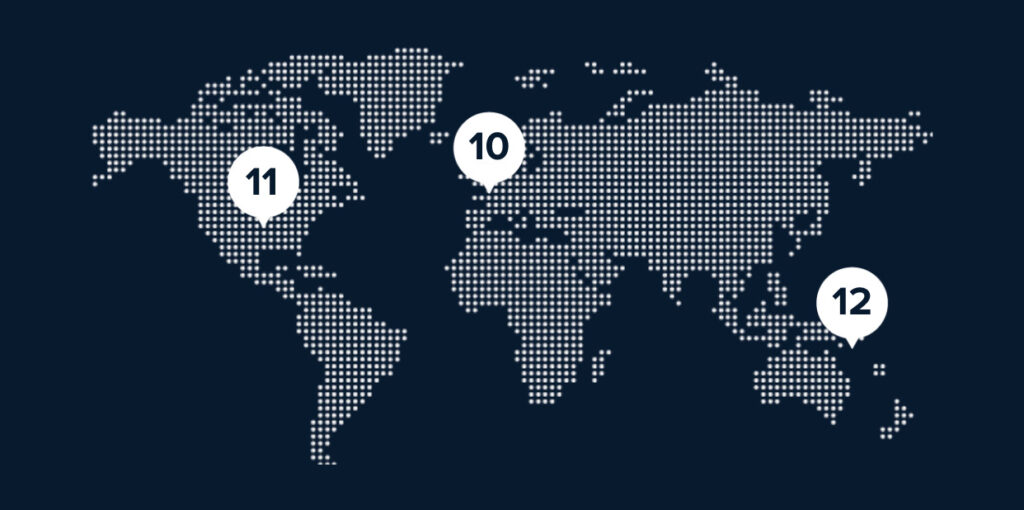
North America

2022 was a year when the world began to travel again. It has been a busy year for visitors to the US, with the borders opening up earlier in the year, many New Zealand companies made their first trip to the US market in more than two years. Many of the trends we saw in 2022 will continue to be a key focus for businesses in the coming year, with a lot of uncertainty around economic climates, sustainability and the lingering effects of Covid. 

Governments and companies will be under pressure to continue to tackle these challenges and businesses will need to make sure that environmental, social, and governance (ESG) processes are at the centre of strategic plans.

In the US we continue to see more and more consumers looking for credible and authentic products and services when choosing to part with their hard earned dollars, and that trend will continue to grow next year.

As businesses plan their 2023 travel, it is worth remembering that July and August are the two months of the year when the US closes for its annual summer holidays. It can be hard to pin meetings down during this time of the year. Also worth noting is that the US briefly stops for a week over Christmas and New Year, and then it’s business as usual. Although it’s winter here, it is an excellent time to travel to this part of the world for business.

I am looking forward to continuing to unearth the amazing Kiwi in the US next year and to keep helping connect the dots for New Zealand businesses. There will be all sorts of opportunities for US market entry next year and I look forward to assisting where I can. Merry Christmas.

Gary Fortune, Kea North America Regional Director

UK and Europe

As the snow falls and London looks like a scene from Narnia, it’s a chance to reflect on 2022. A full year back to in-person events and opportunities to connect.

Here in the UK we are still facing challenges, with the cost of living crisis, the backdrop of the Ukraine war and continued strikes across the UK making the end of year Christmas festivities, final meetings in person and time in the office a challenge to navigate. 

This year has been a big one for Kea we have hosted over 1300 Kiwi at events across UK and Europe. As a global team, Kea NZ has assisted over 500 business connections around the globe, with insights, support and further connections. This is at the heart of what we do at Kea, and it doesn’t happen without the wonderful and inspiring community we have. As a region, New Zealand has been at the forefront of government and trade relations with negotiations for both Free Trade Agreements in the UK and Europe secured this year. Ratification and implementation for these agreements should come into force in 2023 and the effects felt by our NZ exporters shortly after. Alongside this we have reciprocal improvements to the Youth Mobility Scheme, extending the age of eligibility for the visa from 30 to 35, and extending the length of stay allowed to 3 years. Both sides are committed to the improved scheme being in place no later than 2024 and both sides are working hard to see if it can be delivered sooner. We welcome those looking to head on their OE and take advantage of being a part of a very special diaspora community.

Some highlights for me in the UK and Europe region this year were welcoming our CEO Toni Truslove to the region on her first market visit, sharing a World Class Speaker series with Owen Eastwood and WCNZ’er Angela Kearns and celebrating our Kea World Class Awards where we were thrilled to honour the amazing Katie Sadleir and the incredible work that she does across the globe with various sporting teams and industry bodies and more recently with the Commonwealth Games Federation. Finally, it was wonderful to celebrate with our community in London last week with more than 100 people joining us for our Festive Spin Christmas dinner. A chance to close out the year and see special connections and friendships made.

We have worked with so many NZ companies in the market alongside our NZ Inc and global partners. Thank you all for your time, late night and early morning zoom calls, in-person coffee dates, and the opportunity to connect you with fellow Kiwi and businesses. Wishing you and yours a safe, happy festive season. Meri Kirihimete from us in London.

Sara Fogarty, Kea UK/Europe Regional Director

China

2022 has been a very special year for Kea in China. I am grateful to be able to reconnect with the Kiwi community through my role as China Regional Director. In the past few months, I have met with many energetic Kiwi who are so positive about the future between New Zealand and China. 

With the support of our Government partners, Kea plays an important role in facilitating various events and connections in China. I would like to highlight a few – recently we provided five out of eight outstanding candidates for the NZ-Shanghai Virtual Young Leaders Dialogue in November. This is an event hosted by the New Zealand Consulate-General in Shanghai and Asia New Zealand Foundation marking 50 years of diplomatic relations between New Zealand and China. Kea also co-hosted New Zealand Featured Brands Promotion Reception during the 5th China International Import Expo (CIIE) which introduced nearly 20 New Zealand products that are not yet widely known in the China market and in Kea’s Gift Guide it’s exciting to find that Chinese consumers carry on showing strong interest in products from New Zealand. The People, Country and Business ties between the two countries remain strong. 

This month China gradually lifted the zero-Covid policy. Most people who test positive can now isolate at home and the international traveller’s quarantine policy has been reduced to 3-day home isolation (0+3) from the previous “7+3” and “5+3” practice. It brings a transition to living with the virus across China. The search for international flights has increased 4x compared to this time last month. But it is estimated that the peak of the first wave may come alongside the Chinese New Year holiday. 

Based on the experience of other countries, there is a high hope that China will start to return to pre-pandemic activity in the first half of 2023. This is certainly good news for the Kiwi community here in China and for the business community eager to be able to visit the market once again. 

For those looking to visit it’s important to note that most Chinese businesses will close from Friday the 20th of January until Monday the 30th of January for the Chinese New Year. I hope you all have a very Merry Christmas and New Year.

Rebecca Bao, China Regional Director

Auckland city landscape picture

New Zealand

This year saw the very welcome lifting of Covid related border restrictions in most countries including New Zealand, opening the doors for international business travel, tourism and reconnecting with friends and family.

Kiwi exporting businesses have enjoyed significant progress on trade agreements this year. On 1 March New Zealand signed a high quality, comprehensive free trade agreement with the United Kingdom, one of the world’s largest economies and an important, long-standing partner. The NZ-China Free Trade Agreement upgrade entered into force in April further reducing barriers for exporters and boosting trade. It was a world first for any developed country when New Zealand entered into the original free trade agreement with China in 2008, giving us a unique competitive advantage at the time. On 30 June New Zealand and the European Union concluded negotiations on a free trade agreement.

New Zealand has long standing historical, cultural, political and economic ties to Europe. This FTA creates new opportunities, cuts cost through more favourable access to the EU, and will play an important role in our Trade Recovery Strategy. In November negotiations on the upgrade of the ASEAN-Australia-New Zealand agreement establishing a Free Trade Area (AANZFTA) were largely concluded.

The second half of 2022 was packed with travel – with Prime Minister Jacinda Ardern and Ministers including Hon Damien O’Connor, Minister for Trade and Export Growth and Hon Stuart Nash, Minister of Tourism reaffirming New Zealand’s economic ties, spending time with their counterparts and promoting education, tourism and trade. Trade missions and business delegations were made to countries including Viet Nam, Singapore, Japan, Indonesia, the Republic of Korea, the United Kingdom, the United States and Australia.

Looking ahead to 2023 the focus will be on the Census in March and the New Zealand General Election, for which a date is yet to be announced, but will be no later than 13 January 2024. Held every five years, the Census provides a snapshot of our society at a point in time and helps to tell the story of its social and economic change. Census information is used by government agencies, local authorities, businesses, community organisations, and the public for developing and implementing new policies, research, planning, and decision-making. It helps guide decisions about how to best use public funding, especially in areas of health, education, housing, and transport.

Saya Wahrlich, Global Director, Government & Industry


HOW KEA CAN HELP YOUR BUSINESS GROW

Kea Connect

Kea Connect is a free service that will help your business grow offshore. We connect you personally with regional, sector-specific experts and peers.

READ MORE

Resources

Kea is here to help New Zealand businesses grow offshore. Be inspired and hear advice from businesses who have created their export path.

READ MORE

Jobs Portal

Looking for the right talent for your team? Reach our global Kiwi community through the Kea international job portal. 

READ MORE

Filed Under: Businesses going global

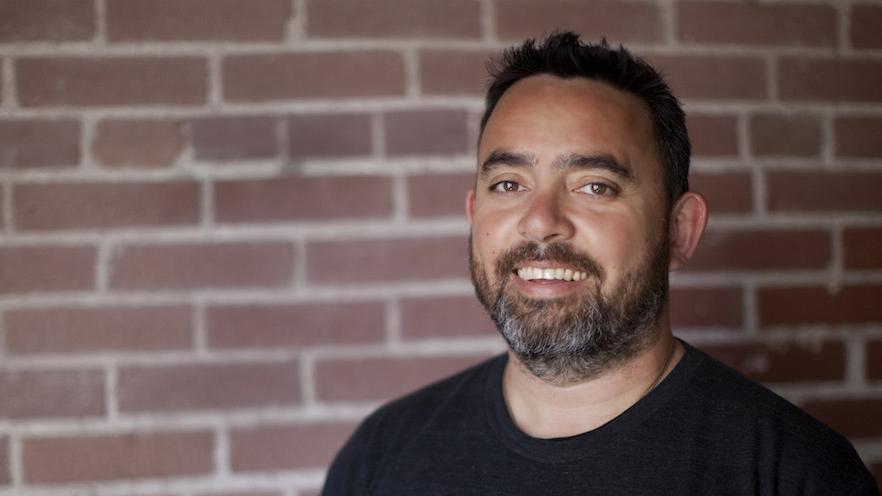
For Tim Brown, Kaitiakitanga, or the guardianship and protection of the environment, is key. So when it came time to hang up his boots at the end of his successful New Zealand football career, he saw an opportunity to create a better future. 

“I realised there was an opportunity to bring natural and sustainable material and innovation to the enormous category of footwear, through a different type of direct to consumer business model. Off the back of a grant in 2014 I created an innovation platform based on merino fibre, I spent $1000 NZD shooting a video to showcase the fibre on the farm of a family friend and launched it on Kickstarter. It was really successful. Following that success I partnered with my co-founder Joey Zwillinger and in 2015 we launched Allbirds from the garage of his mother-in-law’s house in San Francisco.”

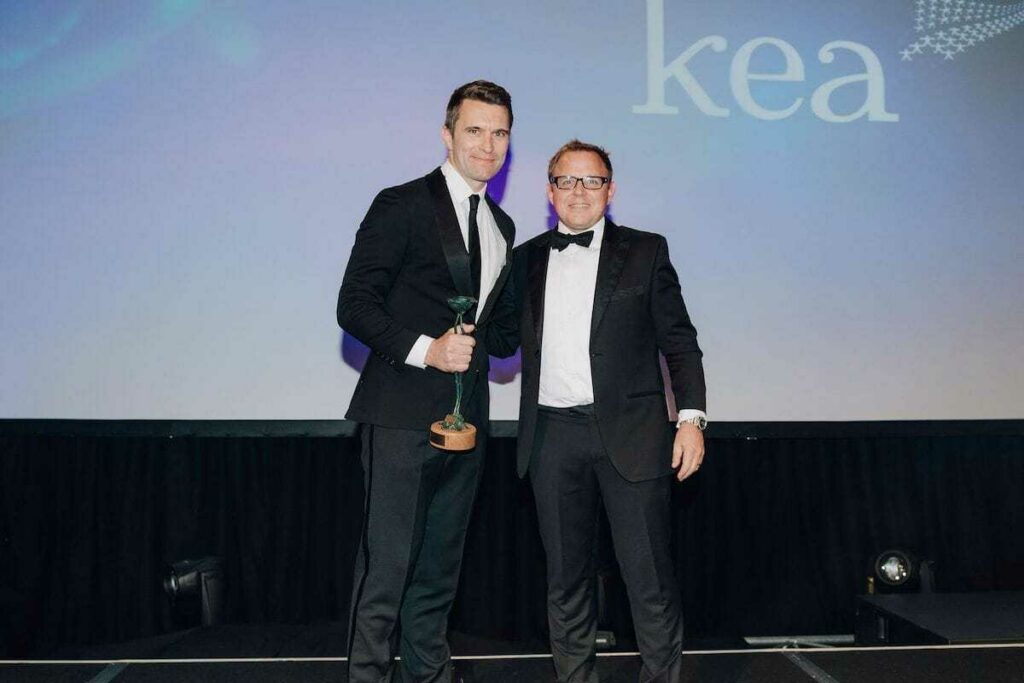
Tim Brown receives his Kea World Class New Zealand Award

In the past five years, Allbirds has become a global phenomenon and a huge Kiwi success story. The company, which once consisted of Tim, Joey and Joey’s dog Walter, has now grown to more than 750 employees worldwide and has expanded their offering beyond both merino and footwear. Time Magazine named Allbirds the “world’s most comfortable shoe” and its investors include superstars like Leonardo DiCaprio. Most recently, Allbirds successfully listed on the Nasdaq Stock Exchange.

Tim says Allbirds has always used carbon emissions as their ‘north star’ but it wasn’t until after meeting fellow Kiwi Zion Armstrong, who was the President of adidas North America, that the two brands realised they shared similar values and had a unique opportunity to do something special.

Zion was introduced to Tim through Kea Connect and says right away he was impressed with Tim’s passion for sustainability and innovation, something adidas is also heavily focused on. 

“Tim and I met for lunch in Portland. It was a positive connection right off the bat. I asked him if he wanted to come up and see our campus. I took him to our Innovation, Research & Development space so he could see some of the things we were working on. At that point it was just two Kiwi guys having a yarn and talking business and discussing how we could do things better. When Tim left I reached out to our Executive Director of Global Brands and said you have to meet this guy, the founder of Allbirds. For me it was about the personal connection and really understanding what both brands were trying to do. We knew at adidas we didn’t have all the solutions, but potentially putting the two brands together we could really create something special. It certainly started off as a Kiwi connection but more importantly it became about what we could do for our planet.”

Zion Armstrong

Tim was also impressed by the work adidas were doing in the sustainability space and says meeting Zion was ‘the New Zealand network in full force.’ However at the time of that first lunch he says a collaboration was the furthest thing from his mind. 

“Zion is a little bit of a legend, in fact a lot of a legend. I just wanted to meet him and learn from a guy who had been in the category for a long time. I had no expectations and was honoured that the bloke would have lunch with me. That meeting through Kea Connect was the initial connection but it was a long time until we really started to think about working together. Zion introduced me to some other people at adidas and we hosted some people, and slowly things started to form. I think in this age of LinkedIn it’s easy to add a contact but it’s much harder to build a relationship. I like to take the time to get to know people deeply, there is no fast track in this sort of work.”

Over time the Allbirds team forged a relationship with the team at adidas and together they started thinking about how the two brands could go further, together. Tim says it was around this time that the concept of creating a shoe with no carbon footprint was born. 

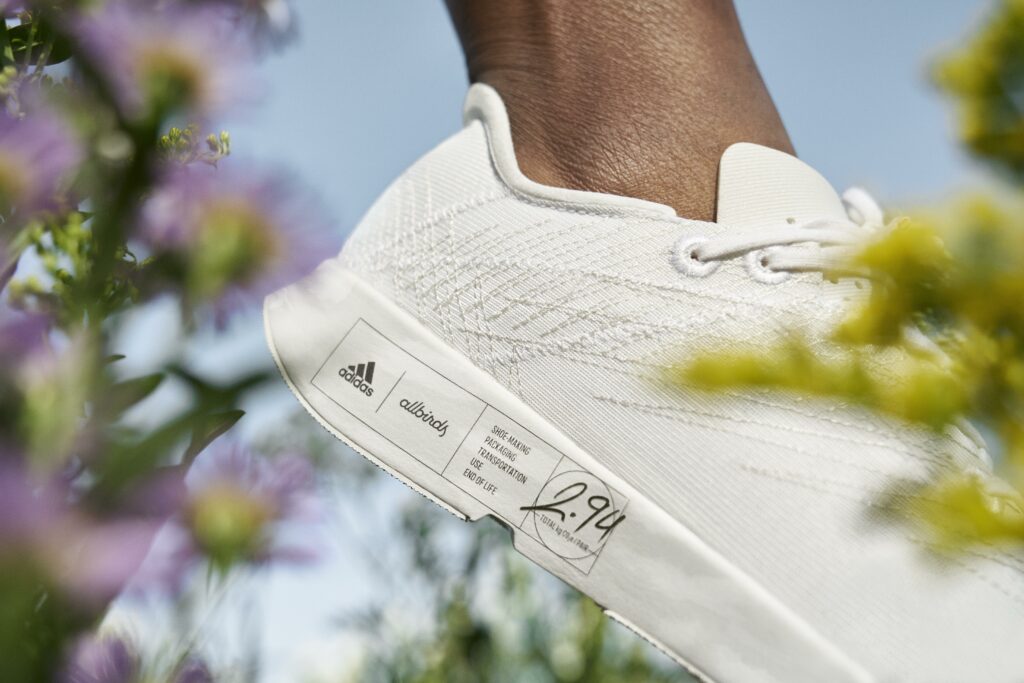
“This idea that a big company that has been around for 70 years or more with all this market experience felt they could work with and in turn learn something from Allbirds, a business which was only five years old, was a huge compliment. I think all of us realised that we could achieve more if we worked together. We focused on this idea of the world’s lowest carbon running shoe and set ourselves the timeline of a year. We wanted to make the idea of reducing carbon emissions tangible for our consumers and give them something they could do right now. To be able to create a shoe using just 2.94kgs of carbon in a little over a year, was an extraordinary achievement.”

It’s hard to attach a carbon footprint to shoes as it’s not something that is traditionally measured and there is a lot of variation within the footwear category. However, early research by both companies suggests the average carbon footprint is somewhere in the low teens, therefore a shoe using less than 3kgs is a groundbreaking achievement. 

The shoe takes less than 3kgs of carbon to produce, traditional similar products use somewhere around 12-13kgs

So groundbreaking in fact that Time magazine has just given the adidas x Allbirds ‘cleaner sneakers’ a special mention on their list of the ‘Best Inventions of 2021’. But for Tim and Zion the shoe is just the start of what can be achieved. 

Zion says if brands are serious about sustainability then the biggest learning is how to make a lower carbon shoe but how to move forward together for a better outcome for all. 

“Traditionally in the footwear space companies don’t work with competitors, but from the beginning there was a higher challenge in play. Addressing climate change requires a major shift in thinking. Sustainability can’t just be the things we need to stop doing, it must be about the things we need to start doing as well.”

Find our how Kea Connect can help your business grow here

Filed Under: Businesses going global

Anton has always been an entrepreneur. His first business venture focused on teaching English to children in Hong Kong and not long after that he moved back to Australia and discovered another opportunity. 

“I was living in Brisbane and my dad got sick, and because of that he had to change his diet. At the time he was really struggling to find foods that didn’t contain some of the ingredients he was trying to avoid so my brother and I started going to the supermarket and recording ingredients off the labels of different products and storing that in a database to help him out. We got asked to leave the supermarket a few times as the staff didn’t understand what we were doing. When we were finally able to explain the supermarket asked if they could buy our data, it was then that we realised that this information wasn’t being collected anywhere.”

Anton and his brother realised at this point that they had found a gap in the market and Label Insight was born. After refining their platform they wanted to collect the data on a larger scale and so took the concept to the US where it proved to be a huge success. 

“On one side we were able to bring on board all the food manufacturers and show them how to use our platform to manage their data, something which has been quite challenging in the past, and then on the other side we had all the US retailers accessing this information to engage customers.”

The final piece of the puzzle for the brothers was to bring on board the US Food and Drug Administration, the governing body of the sector. 

“The FDA wanted to monitor when a new product went live or when a manufacturer changed their ingredients information on the packet and our platform allowed them to do this, it allowed them to monitor the industry in real time. Previously they had sent someone out to physically look at new products or check label changes.”

Label Insight became a fundamental part of the food industry and brought a lot of transparency to the market and Anton says it also made it easier for manufacturers to deliver the information that consumers had started to demand.

“People want to know what’s in their food, they care what they are eating. It’s changed the products that go through the system. We have a load of data that shows over time, how food is changing, how there are less chemical elements and more natural ingredients.”

Along with the success of the data another cornerstone of Label Insight’s success was its company culture. Something Anton says comes directly from his Kiwi roots. 

“I was born in Temuka, so small town New Zealand. My brother and I leant on our Māori roots a lot when it came to the culture of the company. We would have a lot of Americans say to us ‘Wow this is a really innovative culture’ and we were like no it’s not it’s just Kiwi culture. I think because New Zealand is a smaller country and we still live in communities, this gives a lot of our businesses a real edge when it comes to building a strong work culture. It was certainly a really important part of the competitive advantage of Label Insight.”

Label Insight has brought transparency to the food industry

After successfully embedding Label Insight in the US, the brothers sold the business to global data analytics company Nielsen IQ and Anton decided it was time for his next challenge. He moved to France with his wife and started working with NGOs. It was through this work that his idea for his next business came up. 

“I realised there was a lot of work that NGO’s have to do in order to fundraise and distribute money. This takes time away from the work they want to be doing with their communities. Right now I am working on a  block chain solution that will hopefully help these organisations raise and distribute money more easily and allow them more time to focus on the community aspect of their work.”

Anton describes himself as a start up man, and says his expertise lies in working with companies who are in the 1-200 employee stage. Along with his NGO work in France he is keen to help Kiwi companies looking to scale their business and structure their strategy. 

“The growth period of a business between 1-200 employees is a very specific time, there are specific challenges for the company to navigate and getting it right is the key to long term success. A lot of the time I see companies that are trying to be perfect in that early stage and I don’t believe in perfection. I think you need to be scrappy and you need to be out there engaging with customers and selling the value you are trying to produce from day one. But you also need a strong strategy, because that long term strategy is the backbone of your proposition and your success.”

Anton’s various businesses have all been built on technology and while he says businesses should always be investigating new technology to improve their offerings they shouldn’t be distracted by it. 

“I consider myself technology agnostic. Emerging technologies are amazing and fantastic and they will create huge change, but there will always be the next technology. Business must stay focused on the key fundamentals of providing true value and finding out where that value is and how to distribute it. This will always be important no matter the technology. 

Anton is one of our Kea Connect Solvers, Kiwi living offshore who are keen to help our export businesses grow. If you would like to connect with Anton or any of our other solvers today please get in touch.  

Filed Under: Businesses going global

Last month APEC leaders endorsed the Aotearoa Plan of Action, which brings to life the APEC Putrajaya Vision 2040 that was adopted in 2020. You could think of the Putrajaya Vision as the destination and the Aotearoa Plan of Action as the waka to get us there.

This is a bold new approach for APEC, first established 32 years ago to promote cooperation in trade and investment, the group is now broadening into new areas.

Over the year, while New Zealand has been Chair, APEC economies have worked together and agreed to cooperate on digital technology and innovation, environmental sustainability and climate change, and inclusion, particularly of women and indigenous peoples.

The plan sets out a range of clear actions to build prosperity, well-being and resilience. Some are for economies to achieve individually, while others will require multilateral collaboration.

To provide a few examples, there are actions for economies to develop tools to help businesses scale up and operate internationally and cost effectively, to encourage a full embrace of digital technologies to maximise connections with global markets, adopt policies that drive economic productivity and innovation, generate momentum through free trade agreements and the World Trade Organization (WTO) to open more export markets, and to take forward initiatives to enable international travel.

Collective tasks include consideration of climate change when making decisions, and to recommit economies to double their renewable energy use by 2030.

This content was supplied thanks to the Ministry of Foreign Affairs and Trade. To read the Aotearoa Plan of Action in full, visit: http://aotearoaplanofaction.apec.org

Filed Under: Businesses going global

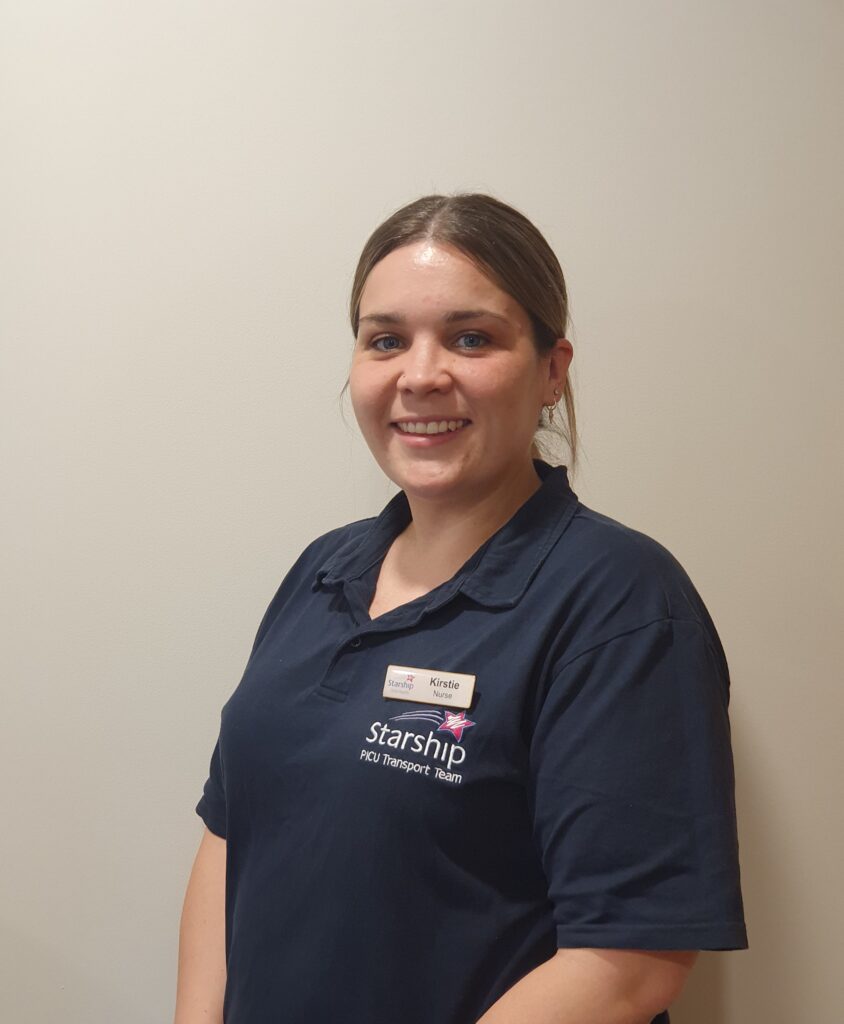
The Air Ambulance retrieves New Zealand’s most critically ill and injured children, bringing them to the country’s only dedicated Paediatric Intensive Care Unit (PICU) at Starship in Auckland. One of the people who sees the positive effects of this service every day, is flight retrieval nurse Kirstie Johnson.

Flight retrieval nurse Kirstie Johnson

Kirstie has been working as a PICU Nurse for nine years and has been part of the flight retrieval team for the last eighteen months. In that time she estimates she has done around 30 retrievals. She says people don’t really think about the Air Ambulance until the day they need it. 

“When your child needs help they need it fast, that’s why the Air Ambulance is so important. Starship provides specialised paediatric services that aren’t available anywhere else in the country. To be able to get kids to Auckland is often a matter of life and death.”

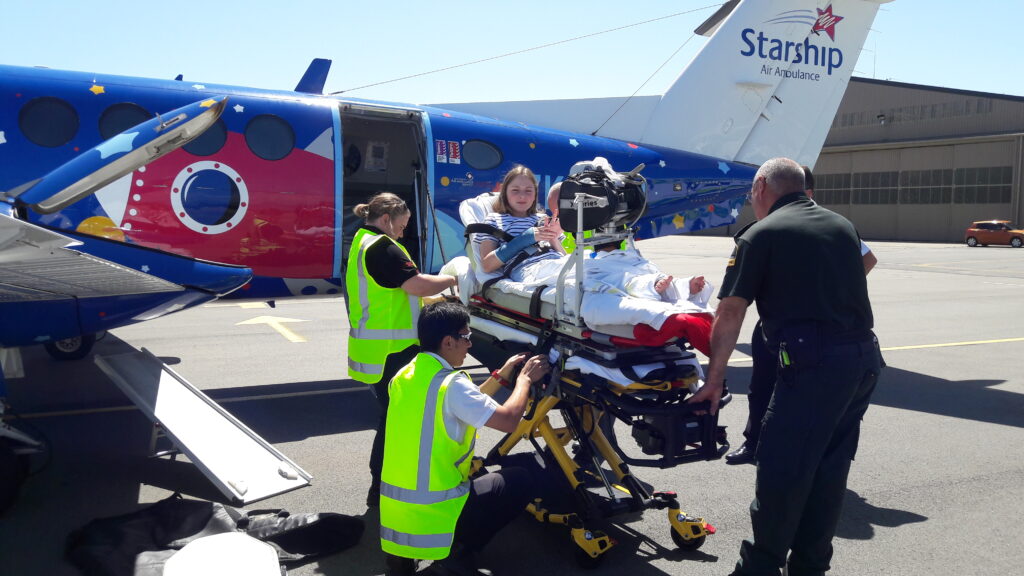
The Boyce family knows just how crucial the service is, 14-year-old Amelia was hit by a car while using a pedestrian crossing last year, just six days before Christmas. She suffered numerous injuries including three skull fractures, concussion, and a broken hip. The seriousness of her injuries meant she needed the Air Ambulance to transport her to Starship, in Auckland. Her parents Adria and Dean say they’re incredibly grateful to the team. 

“Starship and the Air Ambulance is an amazing life support which the whole of New Zealand relies on. The dedicated and experienced staff helped us through a very difficult time.”

Amelia is loaded onto the Air Ambulance for transfer

This year alone the Air Ambulance has made 145 retrieval flights. Kirstie says she still remembers her first flight, when she was sent to Palmerston North hospital to retrieve a six year old girl who needed the highly specialised care that PICU provides. 

“We transferred the wee girl and her mother to PICU and a few days later she was becoming more stable. However, every time her mother saw me on the ward she would burst into tears, because I reminded her of that awful time when her child needed our help. As the girl recovered, so did her mum and she was just so thankful to us. It made me realise just how valuable Starship is for Kiwi kids and their families.”

Supporting family and whānau during the retrieval is a key part of the team’s role. While their primary focus is the patient, Kirstie says they are talking to the family every step of the way.

“When you turn up at the hospital and meet the family it’s one of the most scary and stressful times of their life. We come in with a lot of equipment, our bags are huge. The situation is often critical and parents take one look at us and they get so overwhelmed. It’s such a highly emotional time for them. From the time we arrive at the regional hospital we are talking to the family all the time, talking them through the flight and the transfer and making sure they always know what is happening and what is going on. It’s hard to talk to them on the plane with the noise and the space restrictions, so we try to explain as much as we can to them before we take off. It’s important that they trust us.”

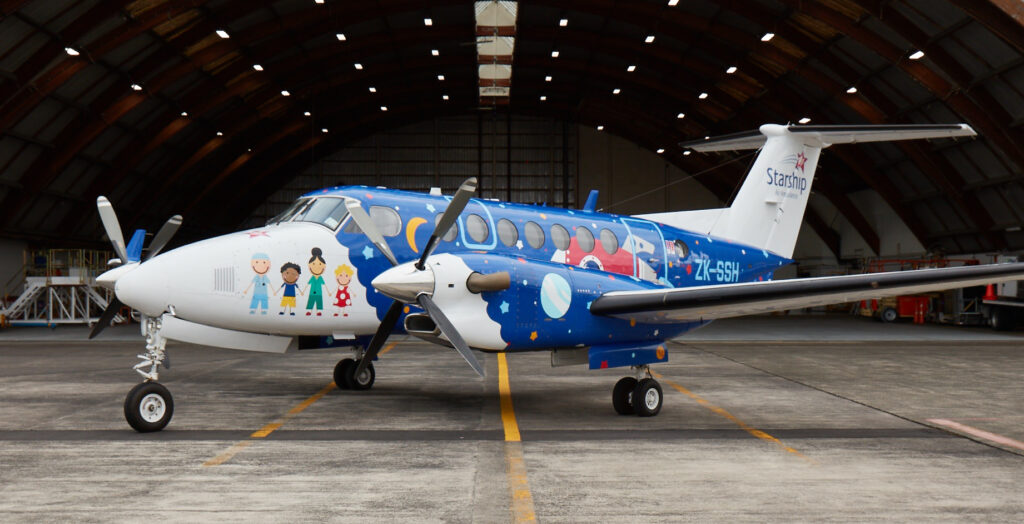
Starship National Air Ambulance

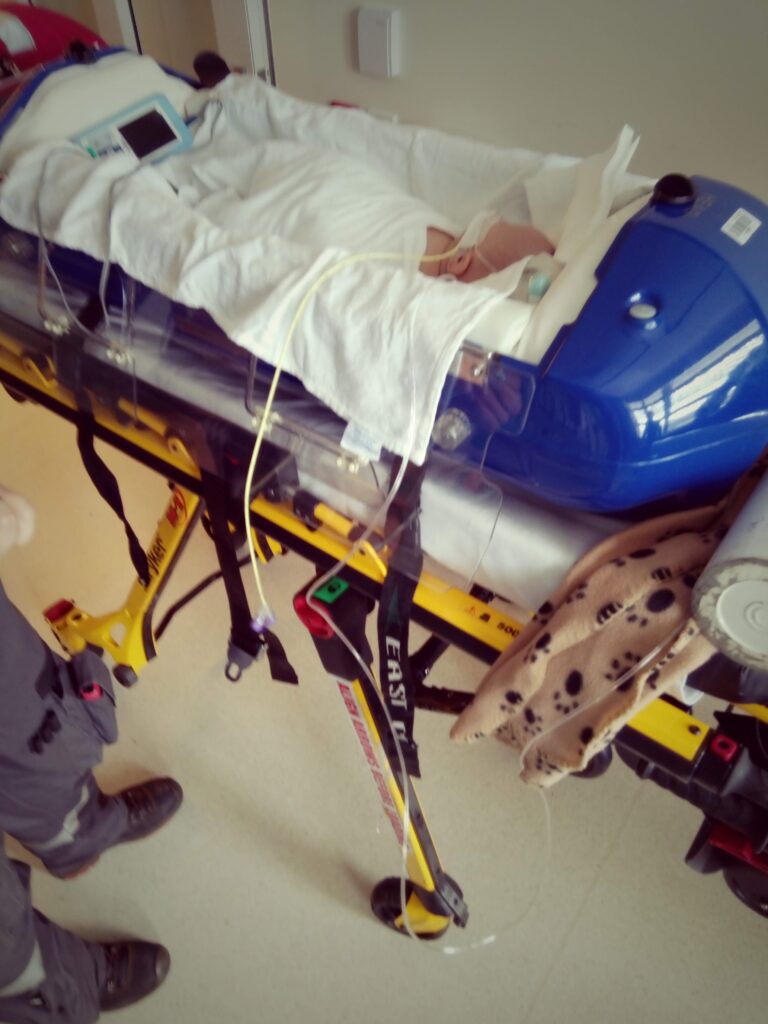
The support the Air Ambulance team provides to the family is something Havelock North mum Tammi is familiar with. Her son Jordan was born prematurely at just 27 weeks. In his two short years he has already had two return trips to Starship via the Air Ambulance. 

Jordan’s first trip came at just six months old when his lung collapsed, and his heart stopped. Tammi says she is so grateful to the Starship team who were there to help her baby.  

“The hardest thing was watching him lie there and not be able to help him. But the team kept me on point – he was in the best care, with the best help, and in the best place. They’re like heroes, like the heroes of New Zealand, I reckon. They kept my baby alive.”

Jordan was able to recover in Starship before returning home. But less than 18 months later, just before his second birthday, a similar event saw him back on the Air Ambulance to receive more specialist care at Starship.  

Tiny Jordan is bought to Starship PICU via the Air Ambulance

For children like Jordan and Amelia the Air Ambulance is a vital service. Without it, outcomes for both families could have been quite different. Kirstie says being able to see the difference the Air Ambulance makes is what keeps her going even during the longest and toughest shifts. 

“I would like to think that if my child needed medical help, they would have the opportunity to be taken to Starship and to get that specialist support. The reason I love my job is because I know the Starship Air Ambulance makes such a difference to people’s lives. It allows children to receive the best possible care. That gives them the best chance to lead long happy lives and there really isn’t anything more important than that.”

We need your help to keep Starship Flying.

Every year the Starship Foundation relies on the support of generous donors to raise around $1.5 million dollars to keep the Air Ambulance flying. You can help by donating at keepstarshipflying.org.nz. 

Alternatively you can gift corporate clients and staff Air Smiles. By donating or purchasing Air Smiles you’re helping critically ill and injured children from around New Zealand get the highly specialised care they need at Starship. Give the gift of Air Smiles this Christmas and help ensure the Starship National Air Ambulance is always at the ready 24/7 for children in need

Filed Under: Businesses going global, Global Kiwi

The aim of this series is to highlight the incredible stories of our World Class New Zealanders and inspire other Kiwi to push the boundaries of their own business goals and expectations. Our World Class community are keen to use their insights and learnings to help others achieve the same heights of success that they have experienced. 

This month Kea spoke to South American based Kiwi Craig Bell. Craig believes the most important challenge for businesses is to make a dollar and a difference. His commitment to leaving his adopted country of Brazil a better place than he found it, has led him to create a groundbreaking South American dairy model based around traditional New Zealand pasture based farming practices and give back to his local community.

What makes Craig really stand out as a World Class New Zealander is his dedication to share his knowledge and insights with a number of other business owners and entrepreneurs both in Brazil and New Zealand. To hear Craig’s story and discover the challenges and opportunities of operating in the South American market.

Watch the full webinar below. 

Filed Under: Businesses going global, Global Kiwi

  • « Go to Previous Page
  • Go to page 1
  • Interim pages omitted …
  • Go to page 24
  • Go to page 25
  • Go to page 26
  • Go to page 27
  • Go to page 28
  • Interim pages omitted …
  • Go to page 43
  • Go to Next Page »

Our Partners

ASB Logo

Kea nurtures a vibrant and diverse community who share a strong passion for New Zealand and the success of its people and businesses

  • Home
  • Kea for business
  • Kea for you
  • Jobs
  • Events
  • News & Resources
  • World Class New Zealand
  • About
  • Contact Us
  • Terms & Conditions
  • Privacy Policy
JOIN MY KEA

© 2026 Kea New Zealand