





• Skip to main content

MENU
  • Kea for business
  • Kea Connect
  • A service facilitating crucial introductions between businesses and industry experts
  • Kea for you
  • Becoming a member
  • Join Kea's global community and stay connected to home wherever you are
  •  
  • Events
  • Connect with Kiwi through local, international and virtual events

  • Kea and our community
  • About Kea
  • Kea Partners
  • Contact
  • News and resources
  • Latest
  • World Changing Kiwi
  • Kiwi coming home
  •  
  • Kea Connect success stories
  • Businesses growing at home
  • Businesses going global
  •  
  • Global Kiwi
  • Launching your global career
  • World Class New Zealand
  • World Class New Zealand Network
  • Award winners 2023
  • Award winners 2022
  • Award winners 2021
  • Gallery 2023
  • Gallery 2022
  • Gallery 2021
  • Gallery 2019
  •  
  •  
  •  
Kea New Zealand

JOIN MY KEA
Kea New Zealand
JOIN MY KEA
  • Home
  • Kea for business
  • Kea for you
  • Events
  • News and resources
  • World Class New Zealand
    • World Class New Zealand Network
    • Award winners 2023
    • Award winners 2022
    • Award winners 2021
    • Gallery 2023
    • Gallery 2022
    • Gallery 2021
    • Gallery 2019
  • About Kea
    • Kea Partners
    • Contact

Sign into My Kea

Register
Forgot your password?

Don't have an account?

This is available exclusively to our Kea community. Log in below or join our vibrant and diverse community of Kiwi explorers.

Join us Login

Businesses going global

Recovery decisions we make now may shape our society for many years to come.

It is from this position that Rebecca Mills, of The Lever Room, has developed Build Back Better a non-partisan Recovery Framework, as a practical contribution to those currently making decisions and spending resources understanding how to best build back better. The process of developing this Framework was aided by The Lever Room’s ability to rapidly convene some of the best global and national thinkers and leaders across academia, impact strategy and investment, science and technology, wellbeing and public health, government, global business and philanthropy.

As a Director, Entrepreneur and Strategist, Rebecca Mills has dedicated two decades to tackling some of New Zealand’s and the world’s toughest social, environmental and economic challenges. In producing this recovery framework it was her intention to ultimately contribute into the process of creating a healthier, more resilient and prosperous society for all New Zealanders.

Build Back Better has been warmly welcomed by both the private and public sectors as a framework to help move New Zealand from response to recovery and then resilience.

Do you agree with these decision making Principles for Optimised Recovery?

There has been an abundance of interest and feedback to the discussion paper, with many confirming the ‘Principles for Optimised Recovery’ are already guiding thinking, thoughtful conversations and investment approaches to ensure we maximise the positive outcomes for our society, environment and economy.

If you would like to play a part in helping to building New Zealand’s ‘Impact Economy Ecosystem’ (as described on page 13 of the Framework) the Lever Room would love to hear from you! They welcome ongoing contributions and collaborations, as we work together towards recovery and resilience for New Zealand. Contact them here. 

To read more about Build Back Better, you can find the link for the report here.

Filed Under: Businesses going global Tagged With: Covid-19, Recovery

Volcano Coffee Works

Kiwi founded, UK operated Volcano Coffee Works is among the many great coffee roasteries in the UK which has helped forge the coffee revolution here, for which many expat Kiwis are incredibly grateful. Trading through and beyond the economic impact of Covid-19 has many business owners and leaders working to navigate the myriad of information being shared by the government and professional service providers. Volcano Coffee Works Head of Finance, Stewart Morrin has had the unenviable task of deciphering the middle ground between government support, business conditions and financial stability.

Here they share with fellow food and beverage providers the options and considerations available to them during this time of economic disruption.

Cardrona Distillery

Cardrona Distillery made the news for their recent pivot to producing top quality hand sanitiser for their local community, following their having to stop commercial production of its whisky because of the Covid-19 outbreak. Deciding to give away the pure spirit from its gin and vodka stills for use as hand sanitiser. Founder Desiree Whitaker said “We are only a small distillery, it is not something we are set up to do [commercially], but we wanted to be able to do our bit for the community,”.

As another fantastic New Zealand business taking its products to the world, Cardrona encourage people to send a Kiwi made gift to a loved one or if you’d like to learn to upskill by learning the art of cocktail making at home, please consider buying your favourite spirits and upskilling through the recipes on their website. For the New Zealand shop, click here. For the UK shop, click here. 

Crosstown Doughnuts

You would struggle to find many Kiwis in London who haven’t heard of Crosstown. For the past 5 years they have brought to us the latest sensation of sourdough doughnuts. Like so many businesses, Crosstown has been massively affected by Covid 19. Recognising that they could not survive trying to do business as they previously have. But knowing that people still need to be fed, and looking at the capacities they had across logistics, people, product and technology – Crosstown Doughnuts banded together with Millers Bespoke Bakery & The Estate Dairy to create a Collective.

Between these companies they employ hundreds of people in offices, retail shops, logistics and in milk, food & bakery production. They needed to keep as many of these people working as possible. Together they bring you The Crosstown Collective. Using their industry contacts, they have sourced great local fruit & vegetables, coffee and even granola. A UK business with some Kiwi ingenuity thrown in for good measure. You can purchase a food box here.

Other Kiwi businesses in the UK which you can support:

  • Caravan Coffee Roasters. Caravan have announced their opening dates, check their website for details! In the meantime enjoy their artisan specialty coffee delivered straight to your door. The finest beans from around the world, selected and roasted in London. 
  • Clapton Craft. Clapton Craft are a craft beer and growler retailer with stores in Clapton, Kentish Town, Walthamstow, Finsbury Park and Forest Hill. Check out their online store for their full offering! 
  • Hops Burns and Black. Craft beer, hot sauce and records – finally all together. Check out their online store until the Peckham/East Dulwich and Deptford stores reopen.
  • Karma Cola. Good looking, great tasting, do gooding drinks. Good for our planet, our growers, and as good for you as fizzy drinks can be. #DrinkNoEvil. Get yours from Amazon, Ocado and Waitrose online.
  • Koru Kids. Kiwi founded, London based childcare service which specialises in after school nannies and helping families to find nanny shares, and offering Covid-19 Short-Term cover. Trying to work, homeschool and keep your kids calm and happy in this scary time? We can help. We have vetted, trained, energetic nannies in all of London’s neighbourhoods ready to help you with your short-term childcare.
  • Mere Restaurant. This South-Pacific French restaurant has announced it’s opening dates. Check out their website for details!
  • Ozone Coffee Roasters. Roasters of specialty coffee for flavor in the cup at home or in cafes, restaurants, offices and businesses. We are still shipping as usual to your lock-down location – home, working from home and business location.
  • Parkway Taxis. This Kiwi-owned and operated taxi business is available in Devon. If you’re getting off a train at Tiverton Parkway from London Paddington or Reading, look them up.
  • Pics Peanut Butter. Fresh roasted peanuts, lovingly squished in sunny Nelson, New Zealand. Get yours from Amazon and Tesco.
  • Provenance Village Butchers. Provenance is a modern interpretation of a traditional village butcher. They offer a next day delivery service to W1, W2, W8, W9, W10, SW1, SW3, SW5, SW7, SW10, NW6, NW8 and NW10.
  • Sacred Coffee.  We have been enjoying their gourmet coffee and tea for years… and their lolly cake. Gourmet coffee, tea and L&P available straight to your door.
  • SANZA.  Your one stop food shop that bring Australian, New Zealand, South African foods to ex-pats across London and the UK. When you may be feeling far from home, SANZA brings the taste of home to your front door.
  • Sarah Angel Photography.  Sarah Angel is a Surray-based photographer specialising in family photography. With safety measures in place, Sarah’s practice is open for business!
  • Secret Goldmine.  Secret Goldmine produces mouthwatering pies. A Kiwi delicacy which they are now delivering too!
  • Specialist Cellars. Wines of the new world. Melanie Brown has been bringing the best of New Zealand wines to the UK for many years. Jump on line and fill up the cellar.
  • The Laundry. This Brixton based bistro has recently announced its reopening dates. Check out their website for more details!
  • The New Zealand Beer Collective. At the NZ Beer Collective we have scaled back, are following all distancing guidelines and locking things down, but we really don’t know what else to do but keep selling beer. We have put in place a way to buy the beer directly from us, delivered safely anywhere in the UK, at some lockdown pricing. Contact Todd for the latest at [email protected].
  • Tried and True Cafe offer award winning innovative breakfasts, light lunches and serious espresso. Rob and the team look forward to welcoming you to this gem in Putney.
  • Yeastie Boys. New Zealand beer brewed here! Yeastie Boys have been brewing up a storm for the past 5 years in the UK. They want to keep their beer arriving to Kiwi fridges around the nation. Shop now on their new online store, and get a tasty 10% discount with your code of K1W1.

This list isn’t exhaustive and focuses on those who we know are trading through Covid-19 current restrictions. This list will be expanded on in the coming weeks. If you are a New Zealander in Business in the UK and would like to be listed here please contact [email protected]

Filed Under: Businesses going global, Global Kiwi Tagged With: businesses, Covid-19, information, resources, UK

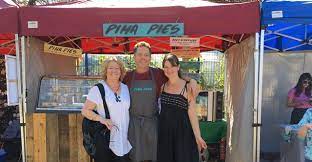
Maryellen, Jeremy, and Jeremy’s half-sister Kate.

How did Piha Pies come about?

I’m from Auckland and moved to the UK in 1991 as a young cameraman and I’m now a Director of Photography working for all the channels including the BBC, C4 and most recently Netflix.

As a Kiwi, I always wondered why you couldn’t get a decent pie in the UK like the ones in NZ. So after many years of talking about it, in 2018 my wife Susanne and I took the plunge and started a little side business making pies from our converted outbuilding in Forest Hill. Then in September that year, we set up our first market stall at Norwood Feast market in South London – and quickly followed up with other markets, pop-ups and events.

We called named it Piha Pies after my favourite beach on the west coast near Auckland, where I spent a lot of time in my teens, and it’s where I return to every time I’m home and I always grab a pie or two from The Piha Store.

The pies were baked on old family recipes. What’s the story behind that?

This is quite a story. I always enjoyed cooking and when I was younger and it was a toss up whether to go into cooking or into TV work. TV work won out and cooking was put on the back burner.  Then about 6 years ago I found out a huge family secret. On a Christmas visit back to Auckland, my mum and dad sat me down and told me that I had in fact been adopted and that my birth mother wanted to get in touch with me. Although this was a massive shock, there was a silver lining…..

3 months later, after the dust settled I decided to find out who my birth mother was, so I tentatively picked up the phone and asked the adoption agency my mother’s name. I immediately googled her and up popped a newspaper article about Maryellen, the owner of a well renowned cafe in Kohu Kohu, Northland – famous for its pies.

Many months later after many email exchanges, getting to know each other and bonding over pie talk and a general love of food and cooking, we met up in NZ. I showed her photos of my childhood and got to sample some of her famous pies, which were laid out for my welcome. Talk turned to my dream of having a pie shop in London one day and plans were hatched to be taught some of Maryellen’s recipes. So, about a year later when she eventually visited me and Susanne in London, she taught me the family pie recipes. All the recipes were in Maryellen’s head, nothing was written down. We spent the next year practising her recipes, perfecting our own recipes and testing them out on family, friends and neighbours.

For our first market, Maryellen and my new-found sister Kate, also a great pie maker, happened to be over from New Zealand. They were able to give helpful advice and were like a lucky charm because the 100 pies sold out and Piha Pies got really positive feedback.

Do you attract mainly homesick Kiwi customers?

There are always lots of Kiwi customers at the pie stall but it is mostly Brits. What is incredible though is the number of British pie eaters coming back across the market to tell us they are the best pies they’ve ever had – which proves the power and draw of the Kiwi pie.

Since lockdown, we have started doing delivery of our pies – and there is a huge proportion of Kiwi buyers looking for comfort food from home.

Are there any particular moments that stand out in your journey?

It was an incredible moment to find out that we had won Best Newcomer in the British Pie Awards this year on top of a few other awards.

But the thing that really ignited our journey was the revelation that after all the years of talking about opening a pie shop my biological mother was already a professional pie maker and she was able to give such invaluable advice on how to start a food business.

Do you have a personal favourite pie?

We love them all and it’s hard to choose which is a favourite. It depends on what mood you’re in but if we had to choose, mine would be Pepper Steak and Susanne’s is Potato Top.

What are your plans for the future?

We want to expand the business so we can start supplying other businesses – we’ve had lots of requests from Delis, Butchers and Cafes to supply them with our pies. We would love to eventually start selling them in high end food stores and supermarkets so Kiwis and Brits across the UK can get hold of them easily. So we will be looking for investment to move into a bigger kitchen and start employing a team to upscale our output and distribution. 

CONTRIBUTOR

Jeremy Huson

Co-Founder

Piha Pies

Kea member

Filed Under: Businesses going global, Global Kiwi Tagged With: Business, Business Growth, london, Market Expansion, piha pies, SME

Kea was pleased to host Paul Hardy – UK Head of Government Relations for DLA Piper,  Lord Barwell – former Chief of Staff of Theresa May, and Nick Swallow, NZTE Trade Commissioner UK & Ireland at our recent webinar.  We covered topics including:

  • What outstanding changes are due to come into force, and what exporters need to know now
  • Key implications of the Free Trade Agreement (FTA) and the Trade and Cooperation Agreement (TCA)
  • How to navigate the updated requirements when shipping into Europe from the UK

Find out how Kea Connect can help you explore new markets here.

Watch the full webinar recording below.

HOW KEA CAN HELP

Join

Join the Kea community, and stay connected to New Zealand, its people and businesses wherever you are in the world.

READ MORE

Jobs

Post job opportunities and attract internationally experienced Kiwi talent.

READ MORE

Kea Connect

Help Kiwi businesses explore their global potential through our worldwide community.

READ MORE

Filed Under: Businesses going global Tagged With: Brexit, Europe, Export, Market update, UK, United Kingdom

Adapting: Shanghai’s first virtual fashion week.

Last year, Alibaba focussed their efforts on NZ and built a local team to help Kiwi brands and producers connect with Chinese consumers. How have you been working with NZ brands, and what success have NZ brands had on the Alibaba platform?

New Zealand is an important market for Alibaba Group for both high quality products exported to China and inbound visitors. Today more than 700 New Zealand brands are selling via our business-to-consumer marketplaces Tmall and Tmall Global and in 2018 we established a local team in New Zealand to better service our clients across the country.

Our New Zealand team’s focus is to help enable local brands, retailers and producers to successfully connect with Chinese consumers and inbound visitors to New Zealand. Building on this success, we were able to successfully introduce our flagship event the Alibaba E-Commerce Expo to New Zealand last year, allowing local companies to network and loop into Alibaba’s wider ecosystem.

There are a number of New Zealand brands which are ranked as some of the top selling products on our Tmall marketplace. For example, during last year’s 11.11 Global Shopping Festival, the A2 Milk Company ranked eighth in the top 10 imported brands bought by Chinese consumers by GMV. In fact, New Zealand ranked 9th of all countries globally for exports into the China market via Tmall and Tmall Global during the festival.

What new retail trends are you seeing in China – from store formats, consumer needs, and how is Alibaba keeping things fresh for consumers?

Especially at this unique time, we are seeing more businesses digitise their offering and connect into e-commerce channels to enable brands to keep up with consumer demand. With this rise in e-commerce, we are also beginning to see new breakthroughs and developments in logistics, aiding retailers to overcome issues of low transport efficiency and high logistics costs.

For example, in 2016 Alibaba brought grocery shopping into the digital era by merging online and offline retail experiences in launching its Freshippo supermarket concept. The supermarkets have soared in popularity with Chinese consumers thanks to its mobile-first shopping experience, 30-minute delivery options and vast selection of products, including live seafood with cook-in-store options. Within a few years since creation, Freshippo has expanded to about 200 stores.

To expand its reach and capabilities in China, Freshippo has been experimenting with new store formats that cater to the needs of different consumers across the county. While the original supermarket concept remains at the heart of most Freshippo locations, the chain started to introduce new shopping experiences to its portfolio about two years after its initial launch.

The Freshippo brand now includes everything from convenience stores and breakfast pick-up stations to even a shopping mall. As a sign of just how quickly Alibaba is moving, five out of the six new store formats were launched in 2019 alone.

There is also a major global shift towards sustainability and this is something that all online retailers need to consider when it comes to tailoring their distribution strategy. At Alibaba we are looking towards a greener future with more comprehensive green campaigns, such as Alibaba Green Logistics 2020. Enabled through world-class technologies, the campaign represents joint efforts across the Alibaba Group to improve material recycling, packaging, route planning and delivery methods to work towards a greener future.

With the onset of COVID19, how has Alibaba responded? And what support have you provided SMEs during these uncertain times?

At Alibaba Group we recognise that COVID-19 has had an unprecedented impact on a range of industries. During this time, we wanted to do anything we could to help minimise this impact on the businesses within our ecosystem and ensure they have the ability to emerge from this stronger than before. As a result, we have introduced a range of initiatives to help SMEs during this uncertain time such as reduced marketplace, warehouse and logistics fees.

Alibaba Cloud, the data intelligence backbone of Alibaba Group, has also launched a Global SME Enablement Program to provide cloud technology relief worth more than USD30 million (NZD50 million) to new and existing small to medium enterprises around the world. This new program will equip each business with the solutions needed to maintain their companies amid the pandemic, ensuring they emerge stronger and more resilient.

Shanghai recently held Fashion Week entirely online due to the pandemic – a world first. What was the response, and how can brands use technology/digital now to engage with consumers?

Shanghai Fashion Week was a huge success with more than 150 designers and brands livestreaming their autumn-winter 2020 collections online. Opening showcases alone on the first day attracted 2.5 million views, with the total number of streams for the event totalling over 11 million views, generating more than RMB20 million (NZD4.7 million) in GMV.

This event has highlighted the importance of brands embracing a new digitally enhanced world. Particularly in China, young consumers are highly informed and digitised meaning brands need to step up their efforts when it comes to technology in order to attract and engage with consumers. During the COVID-19 outbreak, the popularity of livestreaming surged with Alibaba’s Taobao Live recording a 120% increase in sales during February compared to the same period last year.

There is data from China showing online sales for food and consumer goods have increased over the last two months. McKinsey have also found a shift in consumer preferences away from restaurants, and towards groceries & fresh food. What are you seeing through Alibaba’s channels/platforms and what opportunities are there for New Zealand producers and brands?

The healthcare, fresh food and mother and baby categories are always popular categories for imported products, particularly from New Zealand. However, Alibaba has also seen an enormous increase in the sale of quality pet products. For example, during last year’s 11.11 Global Shopping Festival, cat food was the best-selling category on Alibaba Group’s cross-border marketplace, Tmall Global. In fact, this year New Zealand pet food brand Ziwi won the “Trendiest Brand” award on Tmall Global.

Most recently, New Zealand’s most successful and largest pet food exporter won the prestigious award for ‘Trendiest Brand’ at Alibaba’s Trendiest Brand Awards of 2020. Kiwi produce and products are incredibly sought after in China due to their ‘clean and green’ image and Alibaba strives to enable New Zealand businesses to explore new opportunities. There is enormous potential to build on the 700 Kiwi brands already on our B2C marketplaces Tmall and Tmall Global.

Lastly, what advice would you give to Kiwi businesses thinking about their future in China?

One of the most important things to think about when planning for global expansion is for brands and retailers to fully understand their target audience. Simply taking your product into the China market in the same format as it is being offered in New Zealand will often not suffice as each market has different wants and needs.

One of the best things for New Zealand companies seeking to enter the China market is to spend some time to find the right partner. Our annual Alibaba E-Commerce Expo has assisted hundreds of brands in connecting with our wider ecosystem over the past three years in Australia. This is why in 2019, Alibaba decided to expand this offering to New Zealand. Over the course of two-days, the flagship event attracted over 100 exhibitors and over 13,000 pre-registrations were received online, which meant every one out of ten Chinese in Auckland signed up to explore the trends and opportunities that the Alibaba ecosystem brings to the New Zealand market. In addition, our Tmall Global marketplace has a local team who can guide New Zealand brands through the process of opening a Tmall Global Flagship store, and they have recently held their first virtual Tmall Partner (TP) matching event, connecting New Zealand and Australian brands with TPs in China.

CONTRIBUTOR

Jeremy Huson

Co-Founder

Piha Pies

Kea member

Filed Under: Businesses going global Tagged With: Alibaba, China, Market Expansion

As the founder and CEO of a company with a presence in a range of markets, what unique opportunities do you think the Asian market presents to New Zealand companies?

Asia is a massive region, and in reality each country is very much their own market, with local supply chains, language, culture and currency all very different. What makes Asia great on this front is you can find a niche or get an entry point, and even scale up by just getting one Asian country working, or establishing an Asia HQ in Singapore or Hong Kong and branching out from there.

Asia has three major countries and large markets that stand-out, China, India and Japan. Each of these countries are billion dollar opportunities for almost any product or service, so trying to do more than one of these at the same time is a tall order. Achieving scale in just one will set your business alight, and you’ll have your Asia cornerstone. The other approach with Asia, and one we’ve taken with 90 Seconds, has been to establish a regional HQ in Singapore, as it is in a good central location in Asia.

Key benefits of a Singapore based Asia Regional HQ:

  1. Singapore is the regional HQ for hundreds of the world’s global companies and a node for many Asia HQ’d companies, so it’s got both the buyers and sellers to form your customer base and create partnerships that will help drive your Asia go to market strategy.
  2. English is the primary language which removes a whole world of barriers if you’re an English speaking / Kiwi company. You’ll benefit from having a melting pot of Asian and other international talent and cultures combined. You can build a team who share a common language, but speak 10-15+ languages from around Asia as we have. This enables you to reach and remote control into Hong Kong, Thailand, Malaysia, Vietnam, Korea, China etc with your pan Asia team. It’s a joy.
  3. Putting aside the recent challenges, travelling around Asia from Singapore is easy.It’s cheap, it’s made for business, and departing from and arriving back to your base in Singapore is the nicest flying experience in the world.

Given the travel restrictions and social distancing measures put in place this year, how has this affected the way 90 Seconds operates, and how have you adapted?

For 90 Seconds, the lock downs have effectively killed film shoots, so that’s been a tough, instantaneous hit for us, our brands and creators. But conversely, we have over 12,000 90 Seconds creators, in 100+ countries, so as the lock-downs ease but the travel restrictions and likely slow recovery continue, the idea of flying film crews around (which is what many brands and agencies still do), will seem crazy. Our hyper-local creators become an even more valuable solution than they were before. We’re a completely online platform, so for brand managers and marketers who are stuck at home or not able to travel, using a platform makes more sense than ever. To cater for social distancing and safety, we’ve got clean shoot products in the market now, with specific production workflows to support hygienic and safe shoots in these odd times.

In terms of the company and organisation, the immediate demand hit is significant, and we’ve carefully aligned work, time and pay, especially in direct revenue connected teams, to make sure the company and jobs are stable mid to long term. It’s tough and we work super hard to strike the balance and support people, but it’s truly a different and false economy that’s been created. With the usual freedoms and autonomy taken away, it’s all about the most affected people right-sizing their personal economies to match the company’s shrunken economy, so we all come out together.

From a business development perspective, we’re a pretty online company, but also have sales and delivery teams in seven countries, so the lock-down and travel restrictions really drive the further transition to an ‘Inside Sales’ approach, where teams in one place are managing customers all over the world. This gives companies a better shot at driving revenue in international markets without having to travel as it’s become the norm. Embrace it, video and screen share more than ever, and reach those markets.

I’m also just completing a capital raise, so that’s been tough with Covid-19. I would usually lap the world several times over, from San Francisco, to New York, London, Hong Kong, Australia and Singapore, as the in-person experience is a powerful thing. However with the playing field now online, and investors who usually prefer to meet in person still needing to do deals, these deals are now being done from the lounge, pants optional!

Do you think the inability to travel is going to change the way people do business in the future?

I’m a native internet entrepreneur and built 90 Seconds without any offices or personally being in any one location. I’ve lived in cities across the globe for two decades, so believe it will continue to be valued until it’s mainstream. This disruption to the world is a catalyst to force this change upon people and companies. The idea of travelling and competing for resources from roads to cafes at peak hours has always seemed like the ultimate dead weight on people’s lives socially and financially, the lost productivity is crazy and perpetual.

How do you think how people communicate and share content will change as a result of Covid-19?

Video calls, screen sharing and collaboratively editing content are the basics of building direct relationships between team members, partners and customers. This works incredibly well, and it’s about to go to the next level.

If you could give one piece of advice to SME’s looking to expand into the Asian market, what would it be?

Hire someone local so you’re building a go to market plan in market, with the market. Don’t over formulate things on your own or with your team in New Zealand, make your in market ‘local team’ and potential Asia-based customers and partners part of the process. Like New Zealand, Asian countries value relationships, but Asia also can move really fast and that can be great for business. The region has a very long way to go. Businesses in Asia are always thinking about expansion and only see an expanding market – and as an Asia Pacific nation, Kiwis can join right in.

CONTRIBUTOR

Tim Norton

Founder & CEO

90 Seconds

Kea member

Filed Under: Businesses going global, Global Kiwi Tagged With: 90 Seconds, media, Tim Norton, Video

  • « Go to Previous Page
  • Go to page 1
  • Interim pages omitted …
  • Go to page 37
  • Go to page 38
  • Go to page 39
  • Go to page 40
  • Go to page 41
  • Interim pages omitted …
  • Go to page 44
  • Go to Next Page »

Our Partners

ASB Logo

Kea nurtures a vibrant and diverse community who share a strong passion for New Zealand and the success of its people and businesses

  • Home
  • Kea for business
  • Kea for you
  • Jobs
  • Events
  • News & Resources
  • World Class New Zealand
  • About
  • Contact Us
  • Terms & Conditions
  • Privacy Policy
JOIN MY KEA

© 2026 Kea New Zealand