





• Skip to main content

MENU
  • Kea for business
  • Kea Connect
  • A service facilitating crucial introductions between businesses and industry experts
  • Kea for you
  • Becoming a member
  • Join Kea's global community and stay connected to home wherever you are
  •  
  • Jobs
  • Find and post local and international opportunities
  •  
  • Events
  • Connect with Kiwi through local, international and virtual events

  • Kea and our community
  • About Kea
  • Kea Partners
  • Contact
  • News and resources
  • Latest
  • World Changing Kiwi
  • Kiwi coming home
  •  
  • Kea Connect success stories
  • Businesses growing at home
  • Businesses going global
  •  
  • Global Kiwi
  • Launching your global career
  • COVID-19 recovery
  • World Class New Zealand
  • World Class New Zealand Network
  • Award winners 2023
  • Award winners 2022
  • Award winners 2021
  • Gallery 2023
  • Gallery 2022
  • Gallery 2021
  • Gallery 2019
  •  
  •  
  •  
Kea New Zealand

JOIN MY KEA
Kea New Zealand
JOIN MY KEA
  • Home
  • Kea for business
  • Kea for you
  • Jobs
  • Events
  • News and resources
  • World Class New Zealand
    • World Class New Zealand Network
    • Award winners 2023
    • Award winners 2022
    • Award winners 2021
    • Gallery 2023
    • Gallery 2022
    • Gallery 2021
    • Gallery 2019
  • About Kea
    • Kea Partners
    • Contact

Sign into My Kea

Register
Forgot your password?

Don't have an account?

This is available exclusively to our Kea community. Log in below or join our vibrant and diverse community of Kiwi explorers.

Join us Login

Businesses going global

Maia was born and raised in London by a Kiwi mother and English father. Her mother and Aunty were the founding members of Ngāti Rānana, a London-based Māori culture club, so despite the distance Maia grew up immersed in her Kiwi roots. 
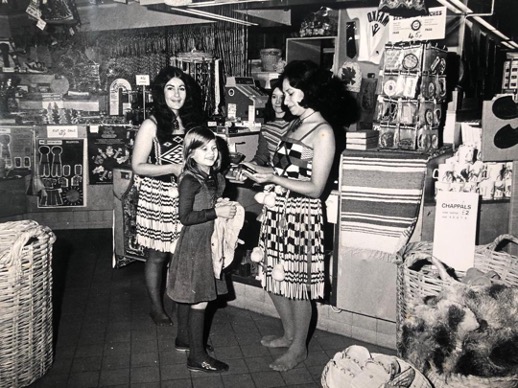
As a child Maia was heavily involved in London’s Māori community through her mother Ester.

“My mother’s iwi is Ko Ngaitai te iwi, from the East Coast near Whakatane, she travelled to London by boat in 1958 and on the way she connected with other Kiwi on board and they would sing Māori songs. Once they landed they all kept in touch and they would meet at my Aunty’s flat and then the community grew bigger and they would gather at the London High Commission, so my siblings and I grew up very much part of that world.”

Maia’s mother worked closely with the New Zealand High Commission often hosting delegations of visiting Māori and Pacific people. As a child she would go home to New Zealand often to visit family, and her Nana would spend long stints in London helping raise her and her siblings. The distance made Maia’s mother determined to ensure her children knew their roots. 

“We’ve always had this kind of bridge to New Zealand. I think I’m, in a way, was more exposed to Māori culture in London than I might have been if I lived in New Zealand. We were kind of straddling both worlds all the time anyway. That’s why my work these days is a perfect fit, because I am used to living in both worlds.”
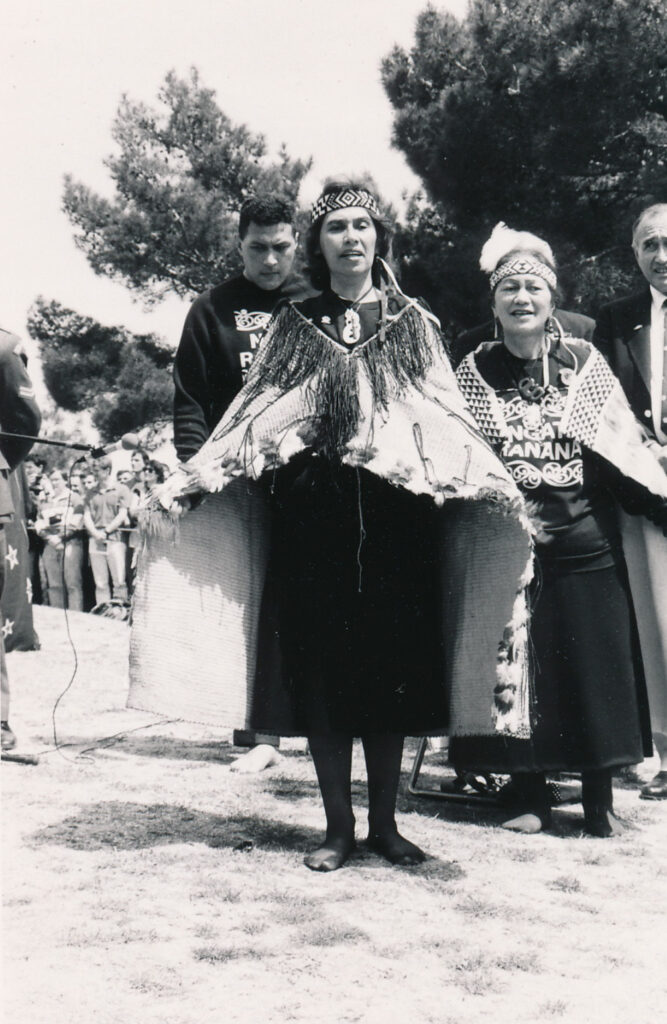
Maia’s mother, Esther Jessop (Ngāi Tai) frequently welcomed Kiwi delegations and visitors to the UK

The work Maia is talking about is her role as the Curator, Oceania for The Metropolitan Museum of Art. She is responsible for around 2800 works of art spanning the entire Pacific. The Oceana display covers 230 cultures and 33 nations and Maia’s main focus is to help people connect and understand the pieces and in turn to understand what it means to be born in and of the Pacific. It’s a role that carries a huge responsibility.

“To be in charge of all these treasures, these taonga carries a huge weight. I really feel like I’m a kind of portal, a bridge to access. We have a duty of custodial care and obligation to the collections and that starts with communities whose Taonga we are safeguarding. Many of these pieces were designed to cement alliances and were exchanged as gifts as part of reciprocal relationships between Māori and Pacific peoples. So I very much view the collections as a kind of active agents and it’s my job to look after their physical care, but also think about their metaphysical care, and open up the space for those people to come and be with their ancestors in our galleries.”

“When this role became available I thought, oh gosh, that’s a big role to step into, but all these elders, these Māori and Pasifika people who I had met throughout my career really endorsed me and supported me. Some of them came through in the first few weeks that I was here and said it’s marvellous to have one of our own here. They felt comfortable to know they could work with me and I could work with them. It was then that I understood that it’s about access, you’re a broker just helping create these relationships between the institutions and the collection and the communities across the Pacific.”

Maia has always had an interest in museums and the histories of collections but it wasn’t until the 1990 anniversary of the commemoration of the Treaty of Waitangi that she realised how she could use her passion to contribute something back to New Zealand and its people. 
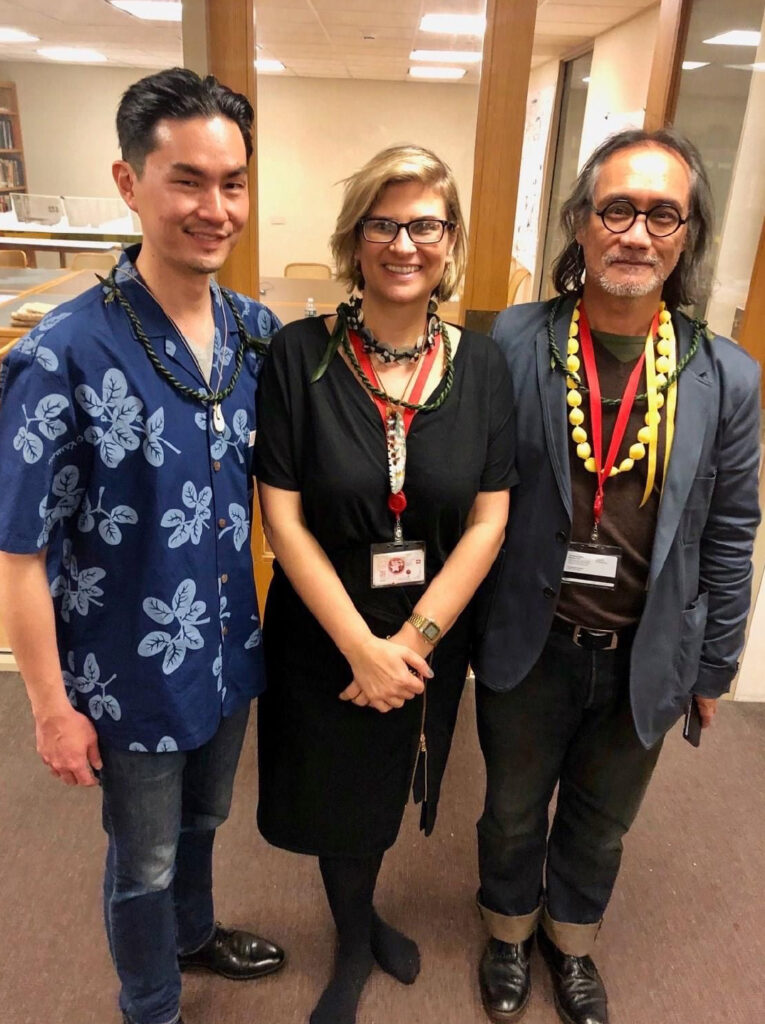
In the US, Maia (centre) carries on her mother’s legacy welcoming dozens of Māori and pacific visitors to to New York and the Met each year.

“The 1990 commemoration was the 150 year anniversary and it was a big year. Mum was involved with a committee and they wrote to all the museums in the UK and some in Europe to ask them about doing little displays that would commemorate the relationship between the Crown and Māori. I was finding myself at dawn ceremonies and openings. In a way I guess that helped me make sense of my own ancestry and heritage and work out how I could play a role in opening up collections and sharing that with others.”

Maia says many people think that indigenous representation in museums is a new thing, or something that has only taken place in recent decades but in fact it was a Maori exhibition led by Maori that first really pushed that agenda almost 40 years ago. 

“In 1984 the Met hosted Te Māori, Māori art collections from NZ and that was a landmark exhibition which was opened by a delegation of Māori who came over specially. It’s still cited as the first exhibition that had indigenous leaders. The exhibition broke all records. There were people queuing round the block to come in and see the show. They took it to San Francisco and then Chicago. For the first time Māori felt that Māori culture was finally on the world stage. When the exhibition went back to New Zealand, they curated another show called ‘Te hokinga mai’ or ‘The return home’ and a quarter of the population in New Zealand came out to see it, and it gave such a jolt to Māori self esteem.”

The Met is currently renovating the galleries that the Oceania collection is stored in and creating a new purpose built space which gives Maia the opportunity to really think about how best she can share the taonga in her care with the wider public. But change always comes with challenges and for Maia one of the biggest was how to bring people along on the journey.  
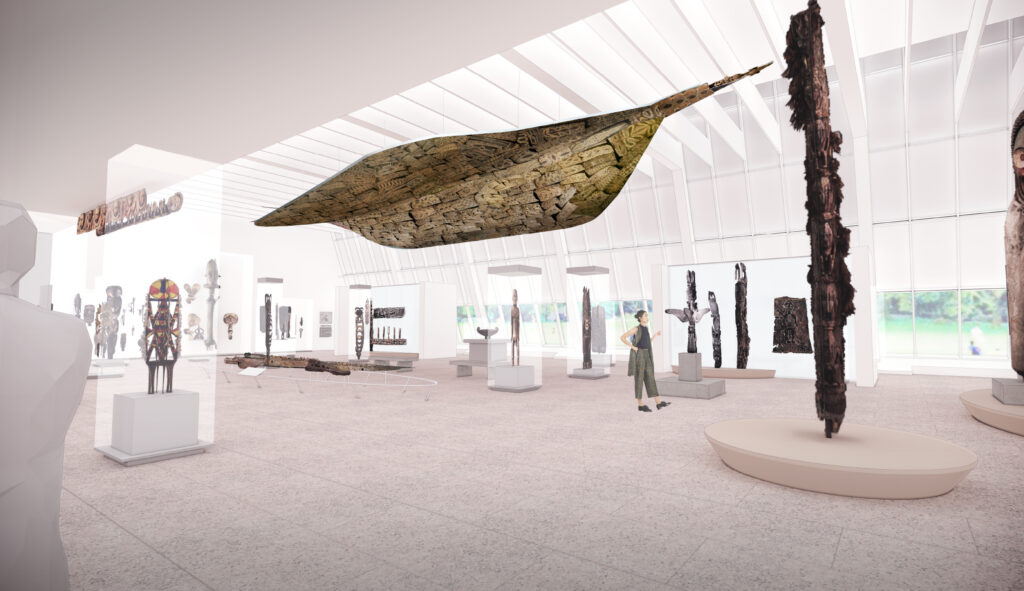
Artists impression of the new space which the Oceania collection will inhabit

“When I started I was a bit worried, I knew I was going to have to push out the borders of the museum, to create change, and then I realised the institution wanted to change it just didn’t know how. So I thought, gentle steps, and we built trust with and consulted with the community. Now with this latest collection, we are going to deal with it quite differently, we’re going to host people and animate the collection with their voices and their perspectives and people are really on board with it. The new galleries will really bring to the centre and foreground indigenous perspectives and so I’m really looking to call out those things which are uniquely us so that we can create our own framework, rather than try and fit the Māori and Pacific collections into an institutional framework that doesn’t fit with us.”

Just like her mother in the 1960’s Maia has also become a firm point of connection for visiting Kiwi, Māori and Pacific artists and visitors travelling through New York. She often has people staying at her apartment and says the visitors help recharge her batteries and give her the energy to keep moving forward. 

“There have been times when I’ve had kind of institutional envy almost of my colleagues who work in New Zealand museums because I know that they’re all on board the same waka, and then there’s me in New York. But I know we need to do it like this, to bring people along with us in this new direction slowly. So I am very much nurtured and re-energised by visitors and artists staying with me, they are part of my own whanau I have created here in New York”
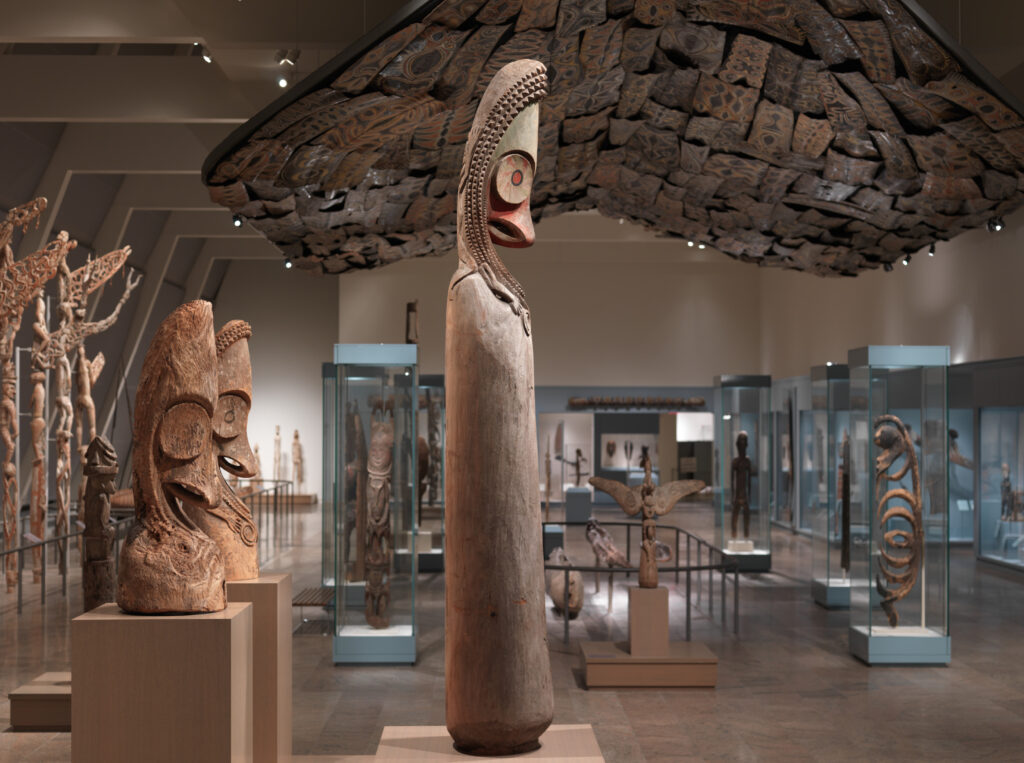
More than 2800 taonga (treasures) from around Oceania are currently in Maia’s care.

Despite living in New York since 2014 Maia views herself as mainly Kiwi and occasionally British. Keeping the connection to New Zealand is something she views as extremely important not just for her but also for her 14 year old son. It’s also a connection that she would like to pass on to thousands of others through her work. 

“You time travel when you are in a museum, you connect with history in a different way, I think it’s the tangibility of things. You can read about history or look at it on your phone, but when you’re actually standing in front of an object, when you can see where a stitch has been missed or the ink swells a bit where the writer paused on this manuscript, you know, you really connect across time and space, and I think that’s the power of it.”

“The more we move into digital realms, I think having a museum becomes a kind of counterpoint, becomes more important. To be able to physically go somewhere and stand in front of a real thing and then see what thoughts come up, that’s powerful. I think a museum is really, a very primal experience, you can really lose yourself in art and in today’s world, that is really important.”
Filed Under: Businesses going global

The survey is intended for anyone who has left New Zealand recently or who is intending to leave in the next year. Please feel free to share the survey with family, friends or colleagues by sharing this page. If you would like to fill out the survey please click here.

We want to get as many opinions and thoughts as possible so please feel free to share the survey across your own networks. We look forward to bringing key findings and insights from the survey in the coming months.

Filed Under: Businesses going global

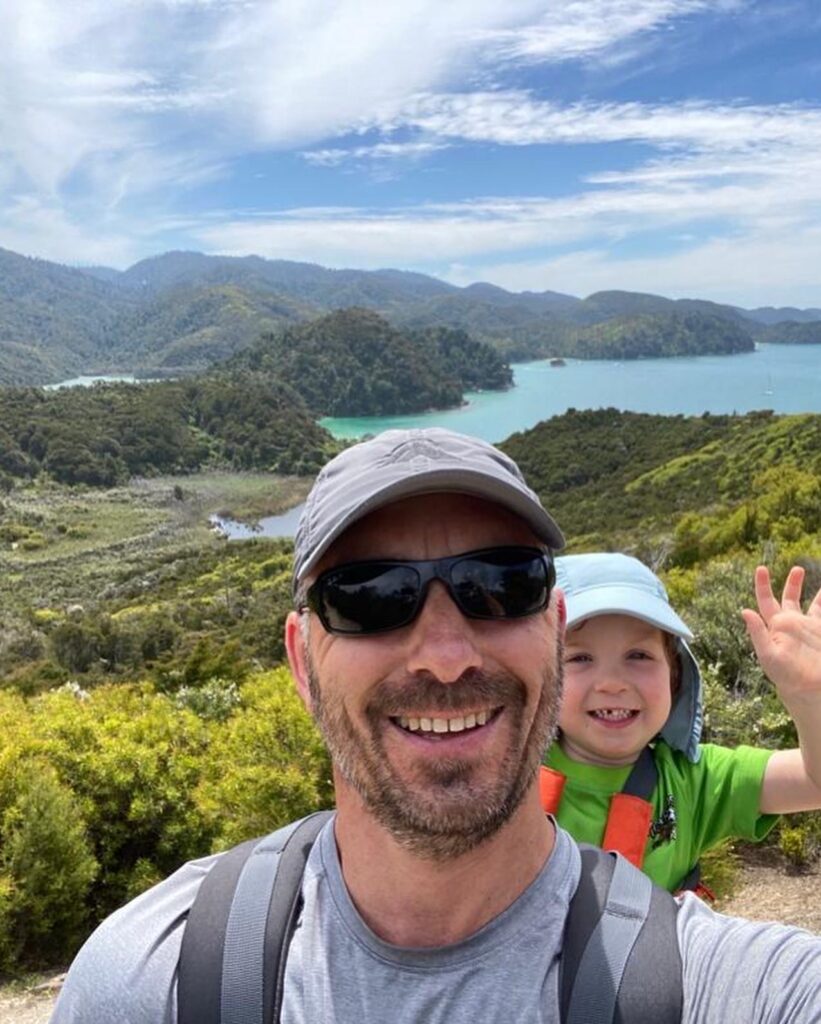
Rebekah remembers sitting on a hill halfway along the Great Walk and making the snap decision to move home to New Zealand. 

“We were in the middle of the Abel Tasman surrounded by all this beauty and I turned to my husband and said ‘we have to move here’ he was in complete agreement and we decided one of our New Year’s resolutions would be moving to New Zealand, that was January 2020. We went home to Australia, and started looking at jobs on Seek. The border closed in March but thankfully we were still able to get in because of my New Zealand citizenship. ”

Rebekah and her family made the decision to come home while on holiday in New Zealand

Moving in the middle of a global pandemic was no mean feat but Rebekah and her family made it through the two weeks of managed isolation in one piece and upon leaving their Auckland hotel picked up their rental car and drove to Hamilton where they stayed the night before driving onto their final destination of Wellington. 

Rebekah was born in the capital and her parents still live there, but when the couple originally planned to come back she assumed they would move to Auckland. Then her husband Rod landed his dream job in Wellington and Rebekah returned to a city that was the same but different. 

“I sort of felt like I had ‘done’ Wellington, but in fact I have fallen in love with the city all over again. Since I have been away Wellington has really grown up. It’s sophisticated, funky and innovative. There are so many areas to explore, it’s such a walkable city and everything is so accessible. For the first year we were here Rod and I would look at each other every day and just grin because we are so glad we moved here.”

Rebekah and her family quickly adjusted to life in Wellington and she credits the fairly easy transition to her kids.

“When you have kids it’s basically impossible not to make friends. They just start playing with other kids at the beach and eventually you end up talking to the parents. It’s funny because I did have some old friends in the city whom I assumed I would kind of fall back in with, but our lives had moved on and things have changed and actually most of my friends now are ‘new’ friends, and most of them have come through connection with our kids.”

Rebekah credits her easy transition home to her children who are loving the Kiwi culture.

During her time offshore Rebekah has lived in London, New York, San Francisco and Sydney. She left New Zealand in her early 20’s and remembers feeling that she had to get out and explore the world because it seemed so much bigger and better and more exciting, two decades on she sees Aotearoa in a new light.

“What we noticed most about coming back was how beautiful everything in New Zealand is and how clean the air is, it’s almost my eyesight improved – everything seems in sharper focus. While we loved Sydney we were getting over the bushfires and the heat and the politics, everything in New Zealand seems softer and kinder somehow. Even the media here is so different, when we left Australia the news was filled with people yelling at each other. We got to MIQ and turned on the 6 oclock news and there was something about a possum and the next story was about some students who’d invented a new toilet.  It was great.”

The other thing that really stuck out for Rebekah was how much more affordable kids activities are in New Zealand, something she says has made a huge difference to their family life. 

“When we decided to move back I started calling Kindergartens to try and get a place because in Sydney anywhere worth going has an 18 month waiting list so I thought I should get on top of it, I called a few places and they laughed and told me the kids could start immediately and then I asked what it cost and was told it was free – in Sydney we had been paying thousands. I had the same experience with swimming lessons and soccer, no waiting list and a third or a quarter of the price of lessons in Sydney. There is so much wonderful stuff to do here, and a lot of it is free or really low cost. There are big family events that cost nothing and are held at amazing places like Te Papa, you just don’t get that in big cities like Sydney.   There’s too many people.  It really lets us do so much more with the kids. I truly believe that there is no better place in the world to bring up children.”

Remote working conditions accelerated by the pandemic has meant that Rebekah has been able to continue her consulting work in Sydney as well as picking up work in New Zealand. She was pleased to find that people were interested in her offshore experience and knowledge and have been keen to listen to her insights. 

Rebekah and her family moved home to be able to experience the beauty of NZ

“What I have found is that it’s been really easy to network in New Zealand. When we first moved back I found a couple of people on LinkedIn who worked in my business area and I messaged them and we met for coffee. In New Zealand people are really willing to meet you face to face for a chat, creating those connections was very easy.”

Rebekah has also been interested to see the way New Zealand’s business landscape has changed and while she feels things have come a long way she also sees some opportunities for Kiwi businesses to learn from their offshore counterparts. 

“I work primarily in the tech sector and there are definitely some opportunities to change the culture of many tech businesses to create a more flexible work environment and to update some of the systems and processes around remote working and managing teams, especially in light of skills shortages. I also think Kiwi businesses could learn from other companies when it comes to training staff and developing skills within a team. I have noticed here that companies often tend to go straight to bringing someone new in when they need to fill a new role rather than looking to develop talent from within.”

Rebekah’s advice to other Kiwi looking to return home is to ‘just do it’ While she accepts that her family have had an easy transition she wants other offshore Kiwi to know that there are great opportunities available in New Zealand if you are simply willing to grab them. 

Filed Under: Businesses going global

The campaign for the extension was led by Every Kiwi Vote Counts, who last year made a submission to the Justice Committee, who are tasked with running the inquiry, recommending that the 3-year eligibility rule (where you have to have visited New Zealand in the last three years to be able to vote) be extended, given Covid’s impact on free movement across the border. 

The Inquiry has just released an interim report, which recognises that ‘International travel to and from New Zealand was severely curtailed in 2020 and while it is not possible to determine how many people were affected, we understand that some New Zealanders living overseas were probably prevented from returning in 2020. This would have affected their eligibility to enrol.’

In response to the report the Government says it will consider introducing an amendment ahead of the 2023 General Election to extend the period of time in which overseas voters may be outside New Zealand while retaining their voting eligibility. It is envisaged that any such amendment would apply to the 2023 General Election. 

Every Kiwi Vote Counts spokesperson, Tracy Lee says this acknowledgement is an important step.

“Overseas Kiwi have had the right to vote since the Electoral Act of 1956 and we are pleased to see their participation protected with these provisions.”

The report recommends the Government ‘introduce an amendment to the Electoral Act 1993 to change overseas voter eligibility criteria to address situations where voters have been prevented from returning to New Zealand by circumstances out of their control, such as a pandemic.’


You can read the report in full here and we will continue to update you on any progress.

Filed Under: Businesses going global

To remind you of the power of the Awards we would like to share this message with you from last year’s Supreme Winner, and one of our 2023 judges, Dame Miranda Harcourt. 

This year the theme of the awards is ‘Togetherness’ this theme has been chosen to remind us all that during these challenging times, we can unify ideas through inspiration and courage from our global Kiwi community alongside those at home, to harness our collective power for greater impact for Aotearoa. 

Our 2023 award winners will be members of our World Class New Zealand network who have embodied the spirit of bringing people together to achieve global success. 

To book your Early Bird tickets simply email [email protected] and one of our team will be in touch to confirm requirements. Early Bird prices are as follows. 

Ticket details Early Bird Pricing

Platinum Table $5250 (+GST)

Standard Table $3600 (+GST)

Individual tickets $375 (+GST)

Pricing from June 9th 

Platinum Table $5500 (+GST)

Standard Table $3750 (+GST) 

Individual tickets $375 (+GST) 

The World Class New Zealand Awards are a spectacular night of networking and celebration This premier black-tie event is attended by more than 700 of New Zealand’s most influential business people, Government leaders and Kea’s wider community. We look forward to you joining us to celebrate this September. 

Filed Under: Businesses going global

North America

AI is a hot topic right now in the US, with Congress grappling with how best to regulate it. This month leading tech CEO’s spoke at Congress about three big questions related to regulation: does the US need a new federal agency? Who owns the data AI trains on? How much will AI influence the 2024 US election? This conversation comes as a recent World Economic Forum report estimated that around 60% of workers will need to be reskilled in the next five years and IBM announced it will slow or freeze hiring for back-office functions representing roughly 26,000 jobs, such as human resources, as it anticipates shifting work to AI. Kiwi companies incorporating AI into their product or service offering should watch closely for any regulatory changes – these could have meaningful impact on the use of AI. Watch this space as the conversation unfolds. 

Good news for South Island exporters planning to visit the US with United Airlines announcement of the first direct flight from the US to the South Island. United Airlines has announced two additional flights connecting New Zealand and the United States, including a direct South Island route. Starting 1 December, United will become the only airline to fly direct between the US and the South Island, with a Christchurch to San Francisco service. United will fly the route three times a week for four months. The airline will also launch an Auckland to Los Angeles service starting 28 October, with flights initially operating three times a week, increasing to four from early December. 

Finally, Kiwi exporters to the US can take their chance at being a winner in this year’s AmCham awards. Entries for the awards close on 30 May, and finalists are interviewed at the end of July. The awards are in their 24th year and celebrate business achievements between New Zealand and the United States – now our third-largest trading partner. Bilateral trade is now worth around $20 billion – goods exports to the USA $7.8b and imports from the USA $7.8b. Good luck to all entrants.

Gary Fortune, Kea North America Regional Director

UK and Europe

This month millions of people around the world tuned in to watch the Coronation of King Charles III. While most of us in the UK watched on TV, a small contingent of Kiwi were lucky enough to attend the celebration at London’s Westminster Abbey. Among the delegation were members of Kea’s World Class New Zealand community, who shared their experiences and emotions with Kea as they took part in the spectacular once-in-a-lifetime opportunity at the historic venue. 

Around 30 Kea community members also joined the welcome reception in London for Prime Minister Chris Hipkins and the New Zealand delegation to the Coronation, which was hosted by the High Commission. Prime Minister Hipkins met UK Prime Minister Rishi Sunak during his visit and both countries agreed to bring forward the entry into force of the Free Trade Agreement to 31 May 2023. The agreement was celebrated by exporters from both countries, with Prime Minister Sunak noting the deal will unlock new opportunities for businesses and investors across New Zealand and the UK, drive growth and boost jobs. 

The UK is New Zealand’s seventh largest trading partner and a crucial market for some of our key exports. From day one New Zealand exporters will save approximately $37 million per year in tariff elimination alone, so the earlier than expected entry into force is a much-needed boost for our exporters. 
Finally, good news for Kiwi businesses that are established in the UK – they may be able to access a new tax benefit. The new 100% first-year capital allowance for qualifying plant and machinery assets, known as full expensing, came into effect in the UK on 1 April 2023, the intention being to help boost business investment and growth. The new measure will initially apply from 1 April 2023 until 31 March 2026 and it may be extended.

Sara Fogarty, Kea UK/Europe Regional Director

China

Good news on international travel this month, with Air New Zealand resuming daily direct flights to Shanghai as major mainland Chinese airlines also returned. Air China resumed its Auckland service on 2 May, offering 4 direct weekly flights to the capital city of Beijing and Air New Zealand increased its flights to Shanghai from 4 times a week to daily. Air New Zealand and Air China are alliance partners and the two companies will provide approximately 6,500 seats per week between Auckland and China every week. It is worth noting that, at present, passengers still need to make a health declaration and apply for a customs health code when entering China.

On 8 May, Kea was invited to attend the welcome reception on the occasion of the visit by the New Zealand China Council led by Mr John McKinnon, twice former New Zealand Ambassador to China. As the first visit to China in over 3 years, the event showed the importance of people-to-people connections between New Zealand and China. Kea was also invited to attend the opening ceremony of the “Altogether Unique 2023” run by New Zealand Wine in Shanghai on 19 May. It was a great pleasure to meet with Charlotte Read, General Manager Marketing of New Zealand Wine.

Kea co-hosted Kiwi Drinks with NZBRiC on 12 May. The event welcomed over 40 kiwis in Shanghai. It was a great evening to receive not only the “usual visitors” but also business travellers from New Zealand. In particular, Kea member Neil Taylor and his partner Cathy visited Beijing and Shanghai to meet with potential distributors of their possum fur boots. It was a great opportunity for them to meet the local Kiwi community in such a welcoming environment. It’s good to see more business focused visits to China since borders reopened.

Rebecca Bao, China Regional Director

Auckland city landscape picture

New Zealand

Agriculture Minister Damien O’Connor travelled to Washington DC this month to speak at the Agriculture Innovation Mission for Climate Summit. The Government has invested more than $380 million over four years for the reduction of agricultural emissions, seeing early investment in equipment and infrastructure to measure emissions, funding for climate researchers, and the development of methane inhibitor technology. The Agriculture Innovation Mission for Climate Summit is an opportunity for New Zealand to share the work that we are already doing internationally, and to identify opportunities to collaborate on the work that lies ahead.

In a watchout for Kiwi exporters, the EU’s Green Claims Directive is proposing that any environmental claims on products must be communicated and substantiated using set criteria. The Directive is designed to tackle greenwashing regarding the environmental performance of products. The EU exclusively recognises auditing of green claims by public sector bodies, so it’s unlikely that eco-labelling certified by private sector agencies and trade associations – which is the norm here – will be accepted as equivalent in the bloc. Initial conversations with New Zealand industry stakeholders suggest that concerns exist around the risk of member states applying the rules differently and the monitoring and enforcement of green claims. As a Directive, the Greens Claim Directive will be adopted into 27 different national laws and member states will individually be responsible for verifying claims. Finally, New Zealand’s gaming sector enthusiastically received the range of support initiatives announced in last week’s Budget. New funding announced included $160 million over the next four years to introduce a 20% tax rebate for the sector, which was worth $407m in 2022, comparable in size to New Zealand’s wool sector. The rebate would be able to be claimed on spend incurred by game development businesses which meet the threshold of $250,000 in spend per year. Up to $3m may be claimed per individual studio per year. The industry had been calling for a rebate to compete with Australia’s highly competitive rebate and enable developers here to hire and continue to expand their businesses.

Saya Wahrlich, Global Director, Government & Industry


HOW KEA CAN HELP YOUR BUSINESS GROW

Kea Connect

Kea Connect is a free service that will help your business grow offshore. We connect you personally with regional, sector-specific experts and peers.

READ MORE

Resources

Kea is here to help New Zealand businesses grow offshore. Be inspired and hear advice from businesses who have created their export path.

READ MORE

Jobs Portal

Looking for the right talent for your team? Reach our global Kiwi community through the Kea international job portal. 

READ MORE

Filed Under: Businesses going global

  • « Go to Previous Page
  • Go to page 1
  • Interim pages omitted …
  • Go to page 18
  • Go to page 19
  • Go to page 20
  • Go to page 21
  • Go to page 22
  • Interim pages omitted …
  • Go to page 43
  • Go to Next Page »

Our Partners

ASB Logo

Kea nurtures a vibrant and diverse community who share a strong passion for New Zealand and the success of its people and businesses

  • Home
  • Kea for business
  • Kea for you
  • Jobs
  • Events
  • News & Resources
  • World Class New Zealand
  • About
  • Contact Us
  • Terms & Conditions
  • Privacy Policy
JOIN MY KEA

© 2026 Kea New Zealand