
 MENU
MENU







TIME & DATE
Tuesday, February 24, 20269:00 am
LOCATION
Taramea, Queenstown,Queenstown
COST
Earlybird: $750 + GST (available until 31/12/2025), includes lunch; Standard: $825 + GST (from 1/1/2026), includes lunch NZDDebugging Decision Making: A Roundtable for Improving Outcomes
Empower your leaders to make smarter, faster and more trusted decisions
In a world of tight budgets, time pressure, and public scrutiny, even the best intentioned decisions can go wrong. From poor infrastructure planning leading to water and road management problems, to misguided small business decisions, there is often a gap between what’s pragmatically possible and what we settle for.
Many of our biggest challenges arise not just from poor choices, but from a failure to imagine better alternatives. People are often unaware of what is possible. Even under difficult time and budget constraints: we repeat old patterns, overlook viable alternatives and substitute urgency for clarity.
Are we doomed to live this way? No! Viable alternatives often exist – but they depend on utilising a systematic framework for more discerning evidence and values based decision making. Business optimisation is not enough. What values are we optimising?
Transform good intentions into better outcomes
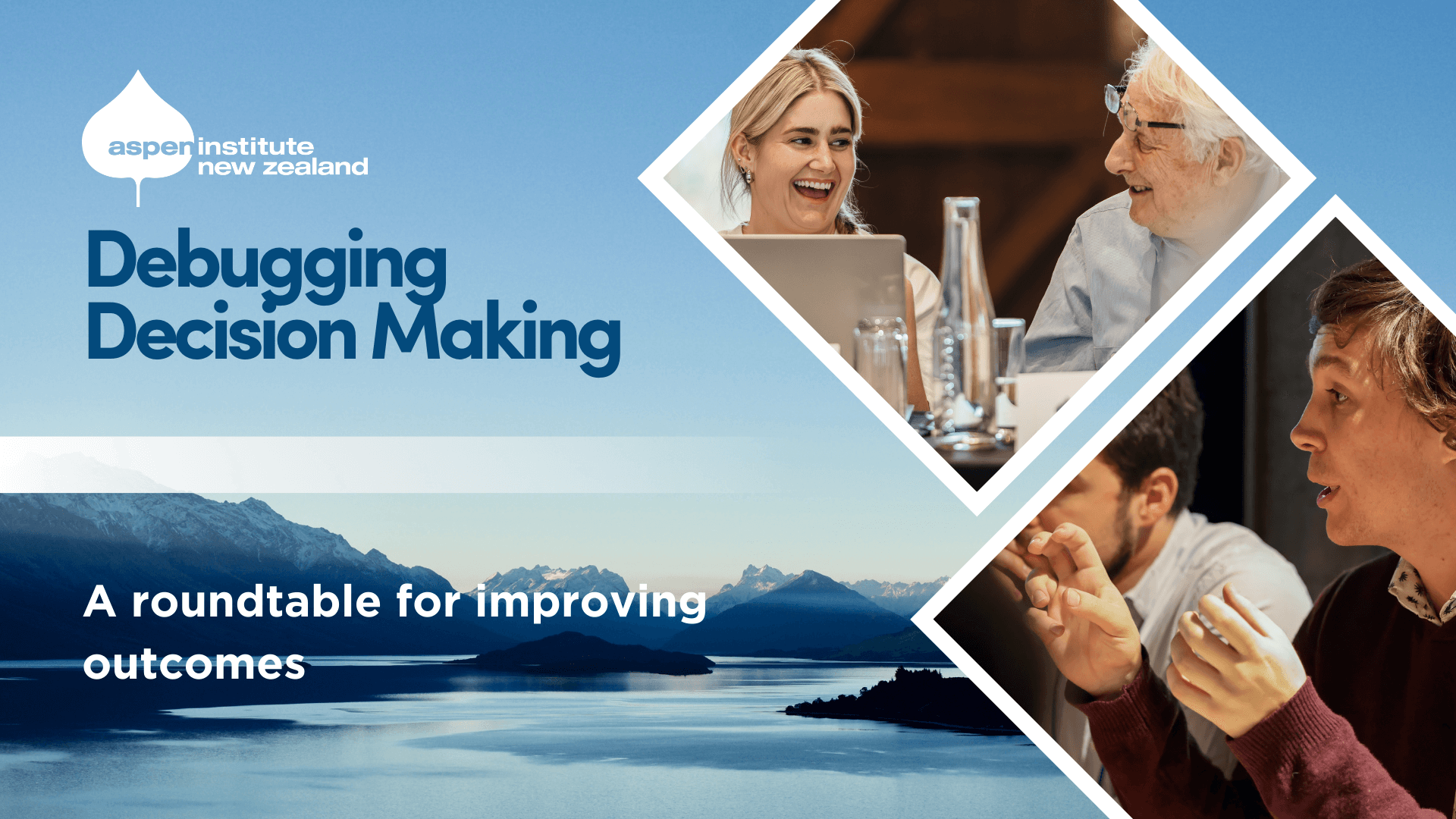
Debugging Decision Making is a fast paced, one day roundtable that helps participants uncover hidden assumptions, test values and avoid the traps that distort well intentioned choices. Participants in this inclusive roundtable use real-world case studies, open dialogue and a systematic decision framework to build stronger, more resilient decision habits. The result: turning good intentions into more possibilities for future actions, and better outcomes.
Led by Neil Jacobstein, an Aspen Institute moderator and technologist with decades of industry and government systems and seminar experience (full bio below).
“This program has equipped me with the skills to make informed, effective policy choices that genuinely reflect the needs and values of our communities. The comprehensive approach to integrating evidence with ethical considerations has profoundly enhanced my ability to contribute to the betterment of our society and country. I am confident that the knowledge gained will significantly impact my work in public service.”
– Nancy Lu, National List MP, Evidence Based Decision Making, May 2024
“This thought-provoking course gave me a practical framework I now apply in every leadership decision. A brilliant return on investment.”
– Evidence Based Decision Making Alumnus, November 2024
Why it matters
-
The stakes are high. Every sector – from business and government to social impact and innovation – faces decisions made under pressure with incomplete information.
-
The opportunity is real. A systematic decision making framework can improve performance, resilience, and public trust – whether leading a boardroom, project, or policy team.
Inside the day
Through guided roundtable discussions, a systematic decision framework, and shared reflection, participants will:
-
Identify recurring decision traps and patterns.
-
Learn to surface hidden assumptions and frame problems more effectively.
-
Explore how values and evidence work together to improve decision-making.
-
Engage with a framework built from New Zealand and international experience.
Who should attend
Leaders, managers, and community members who want to:
-
Make better choices under complexity and constraint.
-
Strengthen ethical and strategic decision making.
-
Build the capacity to act with clarity, confidence, and impact.
Join us
Debugging Decision Making: A Framework for Improved Outcomes
-
Tuesday 24 February 2026, 9am – 6pm
-
In person at Taramea, Queenstown
-
Unrecorded, candid format – Chatham House Rule applies.
-
Earlybird: $750 + GST (available until 31/12/2025); includes lunch
Standard: $825 + GST (from 1/1/2026); includes lunch
-
Limited to 24 people

Led by Neil Jacobstein – a founding AI faculty member and past President of Singularity University. He has extensive decision consulting experience in industry and government. Neil spent 15 years as a MediaX Distinguished Visiting Scholar at Stanford University where his work focused on augmented decision systems. Neil was appointed by the US National Academy of Sciences, Engineering, and Medicine to the Earth and Life Studies Committee, and worked on the Academy’s 2021 Strategic Plan. Neil is a Mentor to the New Voices Program at the Academy. He is an Enterprise Fellow at the University of Otago, a Henry Crown Fellow, and a founding Board Director and seminar moderator at the Aspen Institute in New Zealand. Neil has an inclusive moderating style. He communicates clearly in plain English, ensuring that seminar participant’s perspectives are honoured and common decision biases are addressed. Neil led three longer versions of this successful programme (Evidence and Values Based Decision Making), including one with Māori leadership and two with MPs from across the house at the Beehive. He is committed to creating a learning community, with more rational long term perspectives and better outcomes for participants.
Debugging Decision Making: A Roundtable for Improving Outcomes
TIME & DATE
Tuesday, February 24, 20269:00 am
LOCATION
Taramea, Queenstown,Queenstown
COST
Earlybird: $750 + GST (available until 31/12/2025), includes lunch; Standard: $825 + GST (from 1/1/2026), includes lunch NZDEmpower your leaders to make smarter, faster and more trusted decisions
In a world of tight budgets, time pressure, and public scrutiny, even the best intentioned decisions can go wrong. From poor infrastructure planning leading to water and road management problems, to misguided small business decisions, there is often a gap between what’s pragmatically possible and what we settle for.
Many of our biggest challenges arise not just from poor choices, but from a failure to imagine better alternatives. People are often unaware of what is possible. Even under difficult time and budget constraints: we repeat old patterns, overlook viable alternatives and substitute urgency for clarity.
Are we doomed to live this way? No! Viable alternatives often exist – but they depend on utilising a systematic framework for more discerning evidence and values based decision making. Business optimisation is not enough. What values are we optimising?
Transform good intentions into better outcomes
Debugging Decision Making is a fast paced, one day roundtable that helps participants uncover hidden assumptions, test values and avoid the traps that distort well intentioned choices. Participants in this inclusive roundtable use real-world case studies, open dialogue and a systematic decision framework to build stronger, more resilient decision habits. The result: turning good intentions into more possibilities for future actions, and better outcomes.
Led by Neil Jacobstein, an Aspen Institute moderator and technologist with decades of industry and government systems and seminar experience (full bio below).
“This program has equipped me with the skills to make informed, effective policy choices that genuinely reflect the needs and values of our communities. The comprehensive approach to integrating evidence with ethical considerations has profoundly enhanced my ability to contribute to the betterment of our society and country. I am confident that the knowledge gained will significantly impact my work in public service.”
– Nancy Lu, National List MP, Evidence Based Decision Making, May 2024
“This thought-provoking course gave me a practical framework I now apply in every leadership decision. A brilliant return on investment.”
– Evidence Based Decision Making Alumnus, November 2024
Why it matters
-
The stakes are high. Every sector – from business and government to social impact and innovation – faces decisions made under pressure with incomplete information.
-
The opportunity is real. A systematic decision making framework can improve performance, resilience, and public trust – whether leading a boardroom, project, or policy team.
Inside the day
Through guided roundtable discussions, a systematic decision framework, and shared reflection, participants will:
-
Identify recurring decision traps and patterns.
-
Learn to surface hidden assumptions and frame problems more effectively.
-
Explore how values and evidence work together to improve decision-making.
-
Engage with a framework built from New Zealand and international experience.
Who should attend
Leaders, managers, and community members who want to:
-
Make better choices under complexity and constraint.
-
Strengthen ethical and strategic decision making.
-
Build the capacity to act with clarity, confidence, and impact.
Join us
Debugging Decision Making: A Framework for Improved Outcomes
-
Tuesday 24 February 2026, 9am – 6pm
-
In person at Taramea, Queenstown
-
Unrecorded, candid format – Chatham House Rule applies.
-
Earlybird: $750 + GST (available until 31/12/2025); includes lunch
Standard: $825 + GST (from 1/1/2026); includes lunch
-
Limited to 24 people
Led by Neil Jacobstein – a founding AI faculty member and past President of Singularity University. He has extensive decision consulting experience in industry and government. Neil spent 15 years as a MediaX Distinguished Visiting Scholar at Stanford University where his work focused on augmented decision systems. Neil was appointed by the US National Academy of Sciences, Engineering, and Medicine to the Earth and Life Studies Committee, and worked on the Academy’s 2021 Strategic Plan. Neil is a Mentor to the New Voices Program at the Academy. He is an Enterprise Fellow at the University of Otago, a Henry Crown Fellow, and a founding Board Director and seminar moderator at the Aspen Institute in New Zealand. Neil has an inclusive moderating style. He communicates clearly in plain English, ensuring that seminar participant’s perspectives are honoured and common decision biases are addressed. Neil led three longer versions of this successful programme (Evidence and Values Based Decision Making), including one with Māori leadership and two with MPs from across the house at the Beehive. He is committed to creating a learning community, with more rational long term perspectives and better outcomes for participants.